

For years, brands have been able to perform differentiation.
A campaign could suggest craftsmanship without showing much of the craft. A sustainability story could feel credible because the imagery was quiet, natural and beautifully art-directed. A heritage claim could live in a mood board, a founder quote or a carefully composed about page.
In human-facing commerce, that often worked. Atmosphere mattered. Visual identity, store experience, photography, packaging, partnerships and retail environment could make a brand feel distinctive before anyone asked for evidence.
AI-mediated commerce changes that.
And the change is not confined to visibility. It runs through every stage of how a customer arrives at a purchase: which brands are surfaced, how they are compared, and which one a person finally chooses.
At each stage, brand work has to do something different. And at each stage, the brands that hold their value are the ones whose differentiation was always real.
Key takeaways
- AI-mediated commerce does not flatten brands equally. It separates performed differentiation from proven differentiation.
- The performed kind fades in machine-mediated environments. The proven kind compounds.
- Brand still matters at visibility, but through entity clarity, authority signals and machine-readable structure rather than atmosphere alone.
- Brand work has to operate across three stages: visibility, selection and transaction. Each rewards a different kind of investment.
- Trust infrastructure means the data, evidence, policies and external validation that make a brand safer to understand and recommend.
AI does not flatten brands. It tests them.
The risk is not that AI systems are inherently hostile to brands. It is not that every product will suddenly be reduced to price. And it is not that brand stops mattering.
The shift is more uncomfortable than that.
AI systems do not walk into a boutique and feel the restraint of the space. They do not absorb the texture of a campaign. They do not intuitively understand why a product feels more considered, more refined or more culturally relevant.
They work with what can be retrieved, parsed, compared, verified and connected.
This creates a sharper question for commerce and marketing leaders: when AI systems mediate discovery and recommendation, which parts of your brand meaning survive because they are evidenced, and which disappear because they were only performed?
The real branding question is not only "How do we preserve brand meaning?" It is "Which parts of our brand meaning are strong enough to be interpreted without atmosphere?"
Performed differentiation versus proven differentiation
AI-mediated commerce does not flatten brands equally.
It separates two types of differentiation.
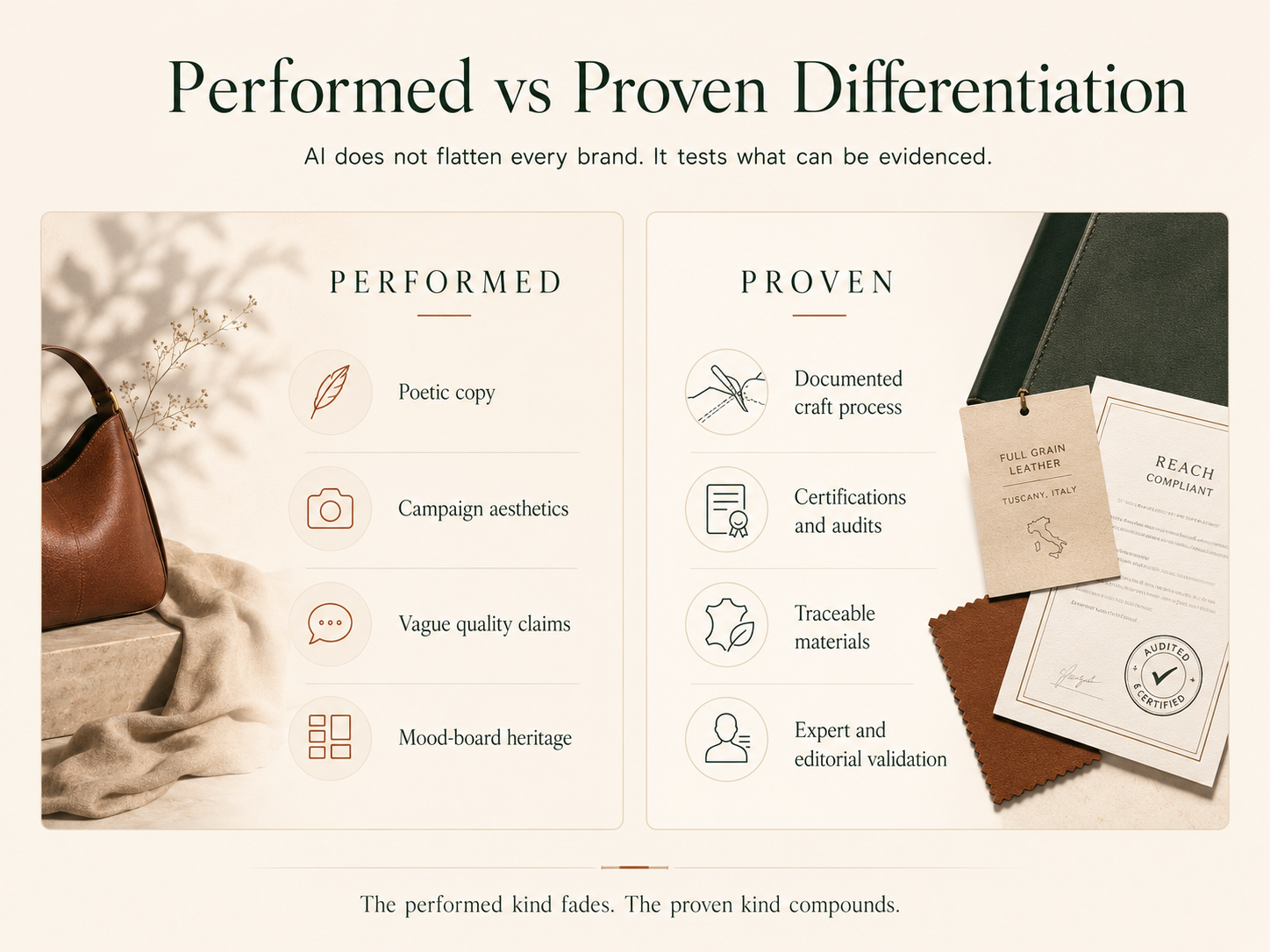
Performed differentiation
This depends heavily on aesthetic signals, campaign language or controlled brand environments. It says "crafted with care" but provides little evidence of who made the product, how it was made, which materials were used or which external sources support the claim.
Proven differentiation
This is supported by traceable processes, named expertise, material evidence, independent validation, consistent disclosures, credible third-party coverage and customer experience that reinforces the promise.
The difference matters because AI systems increasingly rely on evidence around the brand, across owned and external sources.
In one large commercial AI-search analysis, AirOps found that 85% of brand mentions came from external domains, while 13.2% came directly from brand-owned domains. The same analysis found that brands were 6.5 times more likely to be mentioned through third-party sources than through their own domains.
That does not mean owned content is unimportant. It means owned content needs to be accurate enough for others to reference, and strong enough to be corroborated beyond the brand's own website.
By corroborated, I mean supported by evidence beyond the brand's own marketing language. That evidence might include certifications, audit reports, product tests, production records, credible editorial coverage, expert references, customer reviews or consistent disclosures across channels and markets.
- A craftsmanship claim that lives only in poetic copy is fragile. A craftsmanship claim backed by production methods, artisan expertise, material provenance and editorial references is more resilient.
- A sustainability claim that lives only in campaign aesthetics is fragile. A sustainability claim backed by certifications, audit reports, testing and consistent market disclosures is more resilient.
- A heritage claim that lives only in mood boards is fragile. A heritage claim backed by datable history, archived collections, citable references and continuity of expertise is more resilient.
This is the central shift. AI-mediated commerce does not make brand irrelevant. It makes unsupported brand value harder to sustain.
The performed kind fades. The proven kind compounds.
There is no single AI interpretation layer
Another point matters here: there is no single AI system to optimise for.
ChatGPT, Gemini, Perplexity, Google AI Overviews, Copilot and other systems can retrieve, cite and interpret information differently. A brand can be visible in one environment, absent in another, and framed differently across languages, locations or user contexts.
That is why the issue is not only data quality. It is ongoing interpretation risk.
AirOps’ 2026 State of AI Search report found visibility instability across AI answers, with only 30% of brands staying visible from one answer to the next and 20% remaining present across five consecutive runs.
Those figures should not be treated as universal law. They come from one commercial study. But they do support a practical conclusion: AI visibility and recommendation behaviour should be monitored across platforms, not assumed from one result.
Where brand work now sits: three stages, three jobs
Most commerce conversations talk about AI as if it acted at a single point in the buying journey.
A better way to understand the shift is through three layers: visibility, selection and transaction.
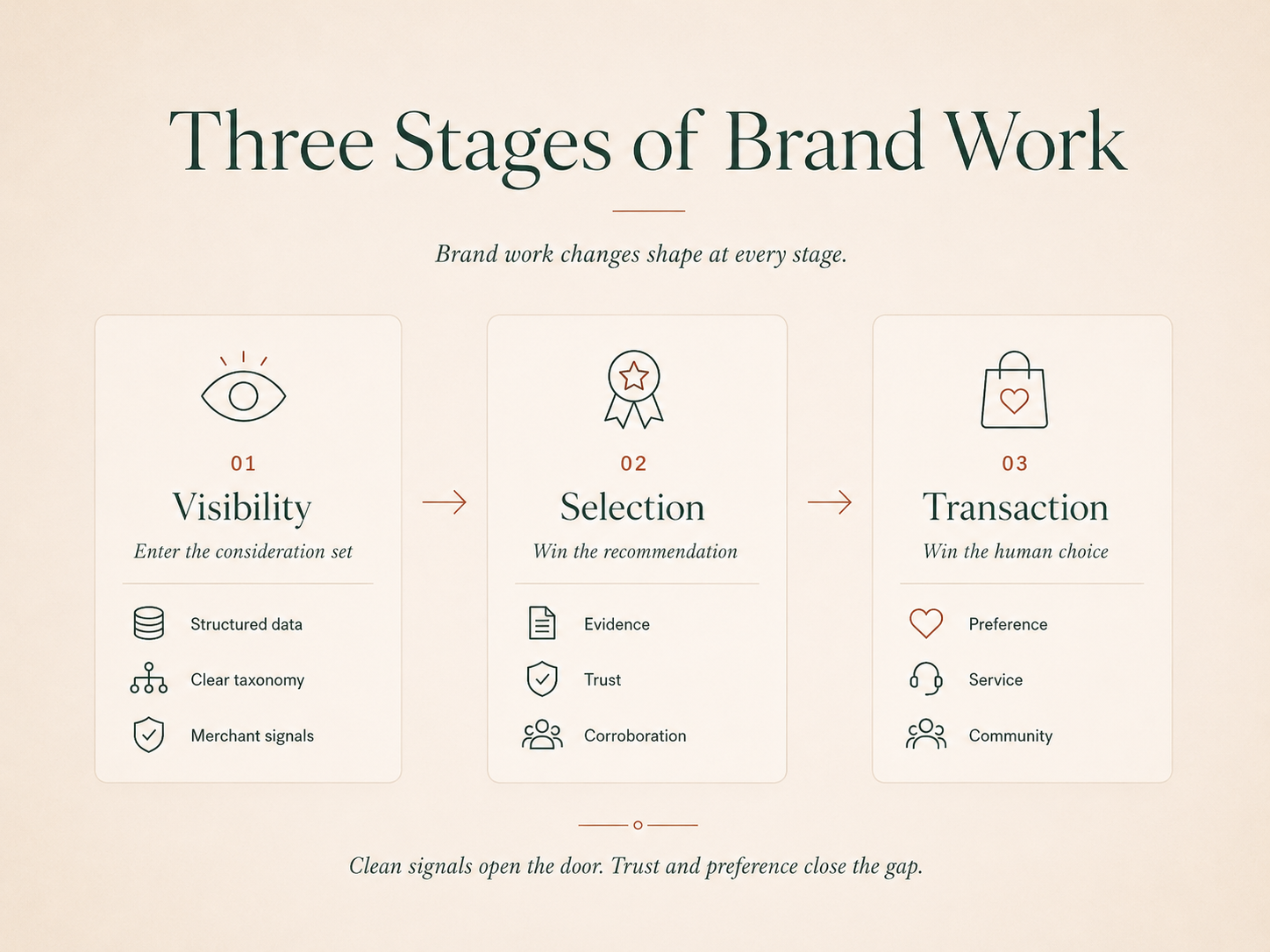
Visibility
AI systems may shape which brands enter the consideration set. Entity clarity, structured data and authority signals are the entry condition.
Selection
AI systems compare, weigh and recommend. Evidence, third-party validation and substantive differentiation help a brand become trusted.
Transaction
The human chooses. Preference, culture, service and trust decide who is actually purchased.
Visibility: the floor, not the ceiling
The visibility stage is where AI systems may decide which brands are legible enough to surface.
This is the stage that most current commerce conversations focus on. And rightly so. Many catalogues were built for human e-commerce journeys: filters, product pages, marketplaces and search.
They were not built for conversational systems that must answer questions such as: "What should I wear to a summer wedding in Lisbon if I want something elegant, breathable and not too formal?"
That type of query requires richer product understanding: occasion, constraint, context, fit, climate, use case and trade-off.
Brands need better product data. Clearer taxonomy. Stronger attributes. Structured data. Availability. Policies. Variant logic. Merchant data that AI systems can parse.
But this is also where brand still matters, just not in the old way.
At visibility, brand atmosphere matters less. Entity clarity, recognisability, category association, trusted mentions, consistent naming and authority signals matter more.
Aleyda Solis makes a similar point in her analysis of brands that win in AI search. She identifies characteristics such as accessibility, usefulness, structure, entity clarity, consistency, credibility, differentiation and freshness.
But clean data is the floor of the work, not the ceiling.
If every brand improves its data, and the direction of travel suggests most serious commerce teams will, the visibility stage stops being a competitive moat. It becomes a hygiene factor.
Clean data wins entry. It does not win preference. If your AI commerce work stops at structured signals, you are competing on visibility while stronger brands compete on evidence and trust.
Selection: where the split becomes decisive
The selection stage is where AI-mediated commerce starts to behave very differently from earlier discovery surfaces.
This is where AI systems may weigh, compare and recommend. And it is where the performed-versus-proven distinction stops being theoretical.
At this stage, the system is doing something more demanding than retrieval. It is asking whether your quality has evidence. Whether your claims can be corroborated. Whether your differentiation is real or only asserted.
It is also asking whether your product matches the buyer's specific context, constraints and values.
This is where brands with documented craftsmanship, verifiable sustainability, traceable heritage and expertise that appears beyond their own website start to compound.
- A craftsmanship claim backed by production methods, artisan expertise and editorial references is easier to corroborate.
- A sustainability claim backed by certifications, audit reports and consistent market disclosures is easier to verify.
- A heritage claim backed by datable history, archived collections and continuity of expertise is easier to trace.
- An expertise claim that appears in independent analysis, industry coverage and specialist commentary is easier to reinforce.
A brand becomes easier to substitute at selection when the system can only understand it through generic product attributes: price, colour, size, material, availability, delivery speed, reviews and returns.
Those attributes matter. But if they are the only legible signals, the brand becomes easy to compare and easy to replace.
This is especially risky for brands whose differentiation depends on vague claims like "premium quality", "conscious design" or "timeless elegance". These phrases can work in a campaign. They are weak as machine-readable evidence.
At selection, AI systems do not simply reward the most-told story. They are better able to support the story with the clearest evidence around it.
Transaction: where the human takes the decision back
The transaction stage is where the buying journey often returns to the human.
The shortlist has been built. The comparison has been made. The system has surfaced options that match the brief. Then a person decides.
This stage is sometimes forgotten in the commerce conversation. The assumption is that if AI can curate well enough, the human decision becomes mechanical.
It does not.
The final decision to buy is rarely made on structured data alone.
This is where brand becomes decisive in a different way. Not as evidence. As preference.
Culture. Community. Reputation. Service. Post-purchase care. Emotional connection. A sense of identity and belonging.
These are the things that make a buyer choose one brand over another from a shortlist of comparable products. The things that make someone return. The things that make someone recommend.
AI can surface options the buyer would have struggled to find alone. It can help verify evidence the buyer cannot check themselves. But it cannot manufacture attachment.
For premium brands, this is not new work. It is the work brand has always done.
What is new is that it now sits on top of two other stages of AI-mediated filtering. A buyer may never reach the transaction stage with your brand unless the visibility and selection layers have done their job first.
AI can get the brand into the shortlist. Brand wins the choice from the shortlist. Without both, the buyer chooses someone else.
What brand work now looks like
For many premium brands, the immediate challenge is not to produce more campaigns.
It is to close the gap between what the brand says and what the evidence around the brand says.
That work has a specific shape.
- Turn craftsmanship into documented process.
- Turn sustainability into verifiable proof.
- Turn heritage into citable continuity.
- Turn expertise into structured authority.
- Turn customer experience into consistent evidence.
- Turn brand values into defensible claims.
This is not about making the brand mechanical. It is about making the truth behind the brand interpretable.
Emotion does not disappear. Aesthetics do not disappear. Human desire still matters. Brand imagination still matters.
But emotion and aesthetics now need evidence that travels through AI-mediated systems intact.
That changes how brand teams allocate their time. Less time on the next campaign in isolation. More time on the product story behind the campaign, the structured data behind the product, the third-party references behind the data, the consistency of claims across markets and languages, and the customer experience that holds the whole structure up.
This is not only a marketing exercise. The work involves product, e-commerce, sustainability, legal, customer experience and data teams. In AI-mediated commerce, brand has more stakeholders than it used to.
Trust signals are now part of brand infrastructure
Trust is no longer only a communications asset.
It is becoming infrastructure.
By trust infrastructure, I mean the data, evidence, policies, disclosures, provenance systems, reviews, certifications and external validation that make a brand easier to understand, verify and recommend responsibly.
AI systems can draw on external signals when forming recommendations: editorial coverage, reviews, certifications, public claims, regulatory scrutiny and customer sentiment. The trust layer is no longer something a brand presents only on its own pages.
It is something AI systems may assemble from across the open web.
That matters in sectors where trust carries commercial weight: luxury, beauty, wellness, baby care, sustainability-led products, technical goods and any category where safety, origin or performance claims influence choice.
Consider origin claims in luxury. "Made in Italy", "Swiss made" or "French craftsmanship" carry cultural meaning for humans. For AI systems, they may also become claims that need supporting evidence.
The brand that can document origin is better positioned to earn recommendation confidence. The brand that only states it gives AI systems less to verify.
The EU direction of travel reinforces this shift, but it does not solve it automatically.
Digital Product Passports, introduced under the Ecodesign for Sustainable Products Regulation, are intended to improve product-level transparency and support circular economy goals. Depending on the product category and implementing rules, they are expected to make more product information available, including data related to materials, sustainability, compliance and lifecycle use.
That can become useful trust infrastructure. But a Digital Product Passport does not automatically make a brand recommendable. The data still has to be accurate, accessible, consistent and meaningful.
The EU AI Act also adds important transparency expectations. Article 50 covers specific situations, including AI systems that interact directly with people and certain AI-generated or manipulated content.
Article 50 does not create a complete governance regime for AI-mediated product recommendations. But it does signal the EU direction of travel: transparency, disclosure and machine-readable accountability are becoming more important design requirements.
The regulatory environment is moving in the same direction as the commercial one: more structured, more documented, more auditable.
The winning brand in AI-mediated commerce is not necessarily the loudest. It is the one whose claims hold up under machine interpretation and human scrutiny at the same time.
This is the deeper consequence of the performed-versus-proven split. Performed differentiation struggles with a corroboration test. Proven differentiation is designed to pass it.
Governance is the discipline that prevents brand meaning from becoming unsubstantiated claims.
What marketing and e-commerce leaders should do now
The immediate priority is not to chase every agentic checkout experiment.
The priority is to understand what your brand value looks like when it is read by machines, recommended by them and chosen by humans on the basis of both.
A practical starting point is to examine four questions.
What do we claim?
List the claims your brand depends on: quality, origin, sustainability, craftsmanship, heritage, performance, safety and customer experience. Then ask which are evidenced and which are mainly performed.
What can be verified?
Identify the proof behind each important claim: certifications, production records, sourcing evidence, audit reports, product tests, historical documentation or credible expert references.
What can be interpreted?
Assess whether the evidence is accessible, structured, consistent and understandable across product data, website content, press coverage, retailer pages and external sources.
What might create doubt?
Map the signals that weaken confidence: vague sustainability language, inconsistent origin claims, missing policy information, fragmented product data or contradictory third-party sources.
This is not only a marketing exercise. It should involve e-commerce, product, legal, sustainability, customer experience and data teams.
Because in AI-mediated commerce, brand meaning is not protected by campaign copy alone.
It is protected by the quality of the evidence system around the brand, and by the strength of human preference that survives once the machine has done its work.
The real conclusion
AI-mediated commerce will not erase brand meaning.
It will test it. At every stage of the buying journey.
At visibility, it will test whether your brand is legible to machines through entity clarity, structured data and authority signals.
At selection, it will test whether your differentiation can be corroborated.
At transaction, it will test whether you have built enough preference, culture and trust for a human to choose you anyway.
The brands most exposed are not the smallest or the least famous. They are the brands whose differentiation depends heavily on atmosphere but weakly on evidence, and whose appeal depends heavily on broadcast but weakly on preference.
The brands best positioned are those whose meaning has substance behind it: documented, consistent, trusted, externally reinforced and emotionally chosen.
If your team needs support assessing whether your brand claims, product data and trust signals are ready to carry differentiation across visibility, selection and transaction, Lex Agentica helps EU commerce teams audit the evidence system around the brand before AI systems shape the buying journey.
FAQ
What is the difference between AI-mediated commerce and agentic commerce?
AI-mediated commerce describes the current phase, where AI systems influence discovery, comparison and recommendation. Agentic commerce describes the emerging phase, where AI agents may execute more of the buying journey, including transactions, under human instruction or defined permissions.
Does AI-mediated commerce make brand more or less important?
Brand still matters, but the job changes. At visibility, brand atmosphere matters less than entity clarity, structured product data and trusted authority signals. At selection, brand differentiation matters when it can be corroborated with evidence. At transaction, human preference, service, trust and loyalty remain decisive.
What does corroboration mean in AI-mediated commerce?
Corroboration means a brand claim is supported by evidence beyond the brand's own marketing language. That evidence may include certifications, audit reports, product tests, production records, credible editorial coverage, customer reviews, expert references or consistent disclosures across channels and markets.
What should EU commerce leaders audit first?
Start with the claims your brand depends on. Then check which claims are evidenced, which can be verified externally, which AI systems can interpret and which signals could create doubt.