
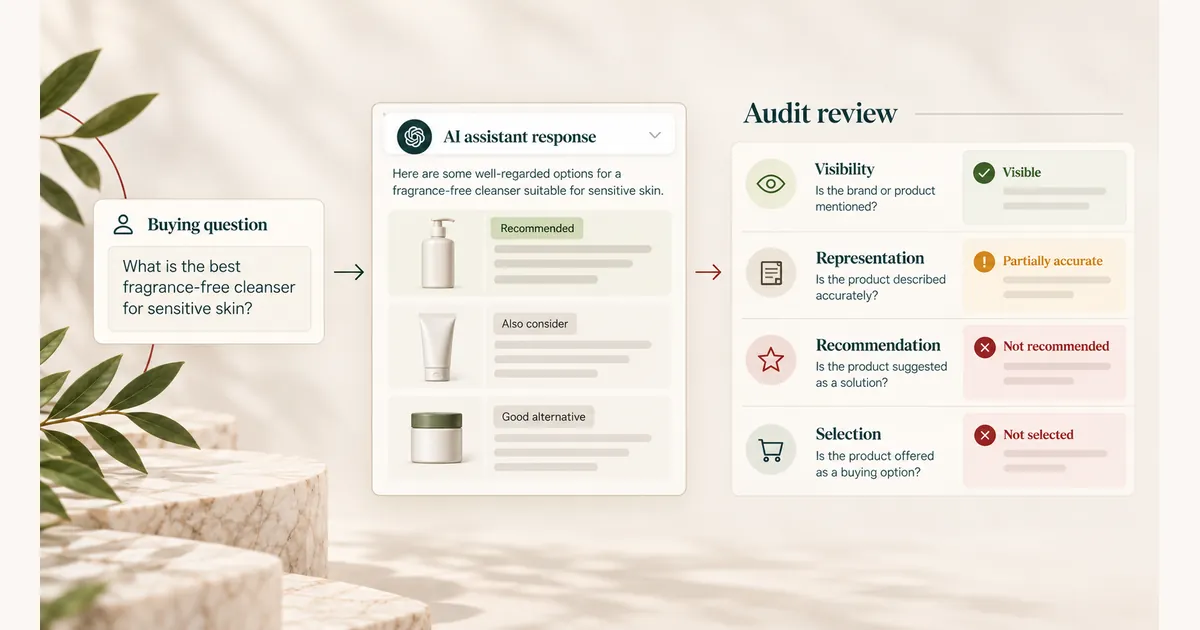
Many ecommerce teams are asking how to get AI to recommend their brand. But before optimising for visibility or investing in a monitoring tool, you need answers to the following questions:
- Does the AI know the brand?
- Does it recommend it?
- Which products does it recommend?
- Which competitors does it prefer?
- How does it describe the brand?
- Which websites does it cite?
- Which visible sources and evidence support the answer?
- Does the AI understand the product correctly?
And perhaps most importantly:
Why does a competitor get recommended when we don't?
This is the basis of an AI commerce visibility audit.
It is not simply a GEO audit. It is not a report saying that your brand appeared in 27% of ChatGPT answers.
An AI commerce visibility audit examines the buying journey from the customer's question through the answer, supporting sources, product recommendation and purchase option. It helps your marketing and ecommerce teams decide what to investigate and correct.
This guide explains how to conduct an AI commerce visibility audit manually, semi-automatically or at scale, organise the findings, and build a correction plan based on the Lex Agentica AI Commerce Visibility Framework™.
We will follow LUMEA, a fictional Italian premium skincare brand expanding across Italy, France and Germany. All LUMEA products, findings and figures below are illustrative. They explain the method and are not completed research results.
For marketing and ecommerce leaders
The audit gives your team a documented baseline and a correction plan with owners and retests. Use it to decide which product information, source gaps and purchase routes need attention.
Appoint an ecommerce lead and involve product or regulatory colleagues in checking facts and claims. Leaders can start with the measurement framework and executive-report section. Your team can follow the detailed steps below or ask Lex Agentica to carry out the audit.
Key takeaways
What you will learn from this guide
- Measure what happens when customers ask AI what to buy. Go beyond brand mentions to check whether your products are found, described accurately, recommended and offered as buying options.
- Build your own audit without immediately investing in another tool. Follow five practical stages, from choosing buying questions and collecting answers to investigating findings and measuring changes. Monitoring software can support the process.
- Combine human judgement with AI-assisted analysis. Use real customer questions, practical prompts and AI tools to organise observations and investigate patterns, while checking important findings against the original evidence.
- Turn findings into decisions stakeholders can act on. Translate product inaccuracies, missing information and competitor recommendations into a prioritised correction plan, with clear responsibilities and evidence for management.
- Find out what needs fixing before investing in more optimisation. Identify problems in product information, claims, external sources and purchase routes. Correct what you can, retest and assess whether further investment is justified.
What the audit measures
The framework examines six parts of the AI-assisted buying journey.
| Layer | Question | What you check |
|---|---|---|
| Discoverability | Does the brand enter the answer without being named? | Brand and product presence in relevant unbranded buying questions |
| Comprehension | Is the brand or product described correctly? | Product identity, positioning, benefits, variants and intended use |
| Verification | Do the stated attributes meet the shopper's requirements? | Ingredients, price limits, certifications, availability and other requirements |
| Evidence | What visible information supports the answer? | Cited pages, claim support, contradictions and source relevance |
| Recommendation | Is the product positively recommended? | Endorsement, explicit preference, qualifications and stated reasons |
| Purchase readiness | Can the shopper reach a suitable purchase option? | Correct product, seller, market, currency, stock and delivery information |
A product can perform differently across these layers.
LUMEA might appear in category questions but disappear when the shopper adds a fragrance-free requirement. It might receive a recommendation but be linked to the wrong variant or it might be accurately described but routed to a retailer instead of the brand’s own store.
Do not hide these differences inside one overall score. That would make it difficult to see which part needs attention.
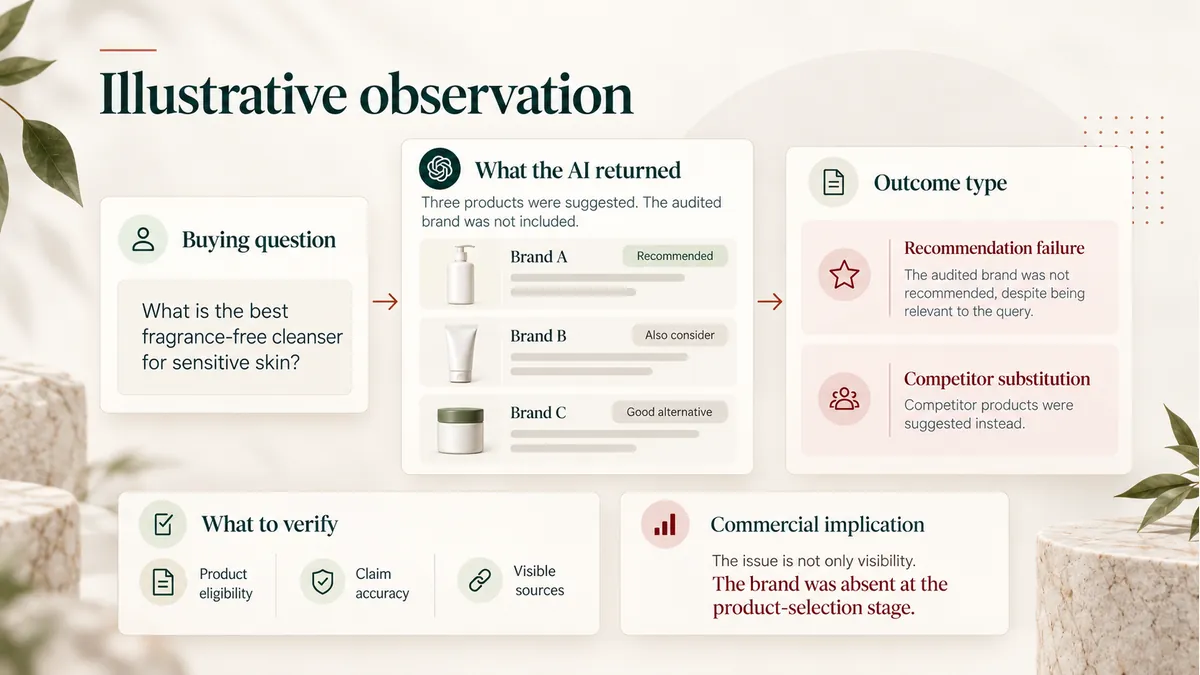
See the difference between brand visibility and product selection.
How to audit your ecommerce store: five stages
Start by defining the commercial question and checking the product facts. Then build the buying questions, collect and classify the answers, investigate the findings, and prioritise corrections before repeating the tests.

1. Preparation
1.1 Define the audit goal
Start with the business question
Before creating prompts, establish what matters commercially.
Imagine LUMEA wants to grow sales of its premium anti-ageing range in Italy. Its priority products include a €79 retinol serum and a €95 moisturiser.
The marketing team wants to know whether AI assistants recommend these products when shoppers ask for premium skincare matching their needs.
Agree on:
- The priority market and customer need.
- The product category and hero products.
- The relevant competitors.
- The purchase channels to examine.
- The business decision the audit should support.
LUMEA's audit question could be:
Can Italian shoppers discover LUMEA when looking for premium anti-ageing skincare, and can AI assistants accurately match our products to their requirements?
This question defines what the team needs to test. It also helps the team choose prompts and decide which product facts to check.
1.2 Set a manageable pilot
A first audit can cover one market and category before expanding to the rest of your business.
A suggested pilot includes:
- One market, such as Italy.
- One category, such as premium anti-ageing skincare.
- Five commercially important products.
- Two relevant AI interfaces.
- Twenty to thirty buying questions.
- Three fresh-session observations of each question on each interface.
For example, twenty questions across two interfaces, repeated three times, produce 120 answers to review.
This is a suggested starting scope, not a universal minimum. Expand it when your team has a consistent way to collect, classify and check the answers.
1.3 Choose the AI services and experiences to test
Do not test every AI service simply because it exists. Include the experiences your customers are likely to use when making relevant buying decisions.
Start with your website analytics, customer markets and available audience research. Consider local availability, the way each service recommends products, shopping links, citations and whether your team can repeat the tests consistently.
Possible systems include ChatGPT, Gemini, Perplexity, Claude, Copilot and Grok, as well as Google AI Overviews and Google AI Mode.
Record the interface and mode separately. For example, Google AI Overviews and Google AI Mode should have separate results. If you test different experiences within ChatGPT, identify which experience produced each answer.
For practical examples of how ChatGPT, Gemini and Claude handle product recommendations, see https://lexagentica.com/blog/ai-product-recommendations-chatgpt-gemini-claude. Use the examples to inform your choice, not as evidence of which service your customers use.
1.4 Choose your tools
You can run the audit manually, use monitoring software or build an API-based collection system. Choose the approach your team can operate and check.
Manual collection
For a first audit, you need access to the AI interfaces you want to test, a browser, a spreadsheet and current product records.
Depending on your scope, you might also use:
- Google Search Console for search questions and observed Google exposure.
- Shopify or your ecommerce platform for product and commercial information.
- Google Merchant Center for product feeds.
- Screaming Frog for technical checks.
- ChatGPT or Claude to help organise and analyse saved answers.
You can collect answers directly from ChatGPT, Perplexity, Google AI Mode or other selected interfaces. For Google AI Overviews, record the search and whether an AI Overview appeared.
Manual collection takes time, but it lets the team examine the answers and decide which information belongs in the spreadsheet before automating the work.
Semi-automated collection
A monitoring platform such as OtterlyAI, Profound or a tool your team already uses can help collect and organise observations. These platforms, as well as relevant tools from Semrush and Ahrefs, support adding your own prompts. Check which interfaces, markets and response elements are available in your plan.
You can combine it with Semrush or Ahrefs for question research, Search Console for Google data, Screaming Frog for technical checks and your ecommerce platform for product information. Google Sheets or Airtable can hold the audit records.
Check what the monitoring platform actually collects, which interfaces it covers and whether you can save the complete answers and visible sources. Your team still needs to define the questions, check product facts and decide what the findings mean.
API-based collection
For larger datasets, an API can help your team collect responses and build its own analysis system.
DataForSEO's AI Optimisation API includes generated LLM responses, scraped platform results, AI keyword data and LLM mention data. Its LLM Responses API supports ChatGPT, Claude, Gemini and Perplexity. (DataForSEO documentation: https://docs.dataforseo.com/)
Generated API responses and answers collected from consumer interfaces are different collection methods. Record which method you use and keep their results separate unless you have checked whether they are comparable.
Manual or software-assisted audit?
You can conduct this audit manually or use software to help collect, organise and analyse the answers. Some platforms also check factual claims and suggest improvements.
If you use a monitoring tool, use its existing answer records rather than repeating every collection step. In Stage 3, check a selection of important results directly in the AI interfaces, confirm what the tool actually captured and verify consequential findings against your product records. If you use a model API, keep its generated responses separate from consumer-interface observations.
Whichever approach you choose, the goal is the same: understand what happens when customers ask AI about products like yours, identify what needs attention and create a practical correction plan. Start by correcting inaccurate or inconsistent information. Create new content where there is a genuine gap, not simply because a tool suggests it.
1.5 Create a product reference record
Before classifying a claim as correct or incorrect, establish which product facts the team will use to check it.
For each hero product, record:
- Exact product name, SKU and GTIN.
- Size, variant, market and formula version.
- Current ingredient list.
- Approved claims and supporting evidence.
- Certification scope, where relevant.
- Current price and availability.
- Date checked.
- Person responsible for validating the information.
Ask the relevant product or regulatory team to resolve questions about ingredients, claims and certification.
If LUMEA wants to be known as "clinically supported", check which evidence exists and which product claims it supports. Intended positioning alone does not establish a product fact.
EU cosmetic-claims rules require adequate, verifiable evidence. Use that evidence when checking claims repeated in an AI answer.(Commission Regulation (EU) No 655/2013: https://eur-lex.europa.eu/eli/reg/2013/655/oj)
2. Build the prompt universe from real commercial data
Your prompt set should not simply be: “500 questions generated by ChatGPT.”
Build it from four sources:
2.1 Gather questions from four sources
Source 1 — First-party data
Use:
- Google Search Console
- internal site search
- customer support
- CRM
- customer reviews
- sales-team questions
- customer interviews
- FAQ searches
- onsite behaviour
Use the standard Search Console query report to identify existing Google search questions. Google's separate Generative AI performance report measures impressions in AI Overviews and AI Mode by dimensions such as pages, countries, dates and devices. It does not supply the underlying conversational questions for this audit. See Google's Search Console documentation: https://support.google.com/webmasters/answer/16984139
But do not treat Search Console as a universal database of conversational AI questions.
The Generative AI report tells you about your site's exposure in Google's generative search features. It does not tell you every question customers ask across ChatGPT, Perplexity, Claude or other AI environments.
Source 2 — SEO data
Use:
- Semrush
- Ahrefs
- DataForSEO
- Google Keyword Planner
- competitor keyword data
- existing keyword research
Look particularly for commercial modifiers such as:
- best
- vs
- alternative
- review
- worth it
- for sensitive...
- under €...
- available in...
- where to buy
- suitable for...
- compatible with...
- recommended for...
Also look beyond traditional keywords.
For example:
“I'm 45, have sensitive dry skin and want an effective anti-ageing serum under €100. What should I buy?”
may have far more commercial value than a generic high-volume keyword such as:
“retinol”.
Source 3 — AI prompt research
Specialist platforms can help identify prompts at scale.
DataForSEO, for example, now provides AI keyword data and APIs for analysing LLM responses, mentions and related AI-search data. Its LLM Responses API supports ChatGPT, Claude, Gemini and Perplexity. (DataForSEO documentation: https://docs.dataforseo.com/)
These tools are useful research inputs.
But treat them as inputs, not ground truth.
Your client-specific prompt universe still needs to be shaped by commercial knowledge.
Source 4 — Strategic prompts
This is where your team's expertise matters.
Some commercially valuable questions will have little or no conventional search-volume data.
For example:
“I'm 45 with sensitive dry skin and want a retinol product under €100. What should I buy?”
That question combines:
- age
- skin type
- problem
- product category
- price
- purchase intent
It is much closer to a real buying decision than a generic category query. You can build it with your team or use an AI system to help generate prompts from suitable business data. Only upload information you are authorised to use in that system. Remove personal or confidential data where required by your organisation’s policies.
2.2 Apply prompt-design best practices
Separate branded and unbranded questions
A question naming LUMEA tests a different task from a question asking for a product recommendation without naming the brand.
| Group | Example | What it tests |
|---|---|---|
| Unbranded discovery | "Which premium retinol serums under €100 can I buy in Italy?" | Whether LUMEA appears without being named |
| Branded evaluation | "Does LUMEA's retinol serum contain fragrance?" | Whether the assistant accurately evaluates the named product |
| Branded purchase | "Where can I buy LUMEA's retinol serum in Italy?" | Whether the assistant provides a useful purchase route |
Report these groups separately. Including branded questions in an unbranded discovery rate would inflate the result because those questions already introduce the brand.
Cover the customer's decisions
Within the groups, include the tasks relevant to your products.
| Customer task | Illustrative prompt |
|---|---|
| Category discovery | "Which premium Italian skincare brands should I consider?" |
| Need-led discovery | "Which moisturisers would you suggest for dry mature skin, available in Italy?" |
| Constrained selection | "Which fragrance-free moisturisers under €100 can I buy in Italy?" |
| Comparison | "How does LUMEA Retinol Serum 30 ml compare with the competing product named in this question?" |
| Switching | "Which alternatives should I consider to the premium retinol serum named in this question?" |
| Claim verification | "Is LUMEA's moisturiser certified vegan? Show the evidence." |
| Branded product selection | "Which LUMEA moisturiser is fragrance-free and costs less than €100?" |
| Purchase routing | "Where can I buy LUMEA Retinol Serum 30 ml with delivery to Italy?" |
For comparison and switching questions, name the actual competing product before running the test. Otherwise, different answers may compare LUMEA with different alternatives.
Use exact product names for product-level questions. "Is LUMEA fragrance-free?" could refer to the entire range. "Is LUMEA Retinol Serum 30 ml fragrance-free?" identifies the product you want checked.
Test requirements one at a time
Start with a base question:
Which premium moisturisers under €100 can I buy in Italy?
Then add one requirement:
Which fragrance-free premium moisturisers under €100 can I buy in Italy?
Compare the answers. If LUMEA appears in the first set and not the second, investigate the difference.
First, check whether the relevant product meets the fragrance-free requirement. Its absence is only a potential problem if it qualifies for the question.
The change in recommendation does not, by itself, explain why the assistant excluded it.
Write for the market
Use the market's language and buying context.
For Italy:
Quali sieri al retinolo sotto i 100 euro posso acquistare in Italia?
For France:
Quels sérums au rétinol à moins de 100 euros puis-je acheter en France ?
For Germany:
Welche Retinol-Seren unter 100 Euro kann ich in Deutschland kaufen?
Ask someone familiar with the market to check the wording, product expectations, retailers and price assumptions.
Keep market and language as separate fields. An answer written in Italian can still link to a US retailer with no delivery option for Italy.
2.3 Create a prompt register
Give each question an ID and record the information needed to group and repeat it.
| Field | LUMEA example |
|---|---|
| Prompt ID | IT-RET-007 |
| Exact prompt | "Quali sieri al retinolo sotto i 100 euro posso acquistare in Italia?" |
| Market | Italy |
| Language | Italian |
| Customer task | Constrained product selection |
| Brand named? | No |
| Category | Retinol serum |
| Requirements | Under €100, available in Italy |
| Source | Customer support and strategic planning |
| Priority | High |
Save the exact wording and reuse it when you measure again. You can add questions later, but report those separately so you can compare the original set with its follow-up results.
2.4 Use AI to sort the questions
AI can help organise customer questions into groups. Supply the questions after the following instruction:
Your team should check the classification and decide which questions have commercial priority.
2.5 Set up your audit spreadsheet before testing
Create one Excel workbook or Google Sheets file with the six tabs below. Each prompt is one row in the Prompts tab; use the same IDs to connect its observations and findings. You do not need separate cards or specialist software.
| Tab | What it holds |
|---|---|
| Prompts | Exact questions and their categories |
| Product reference | Dated product facts, variants, approved claims, supporting evidence and validation owner |
| Observations | Saved answers and test conditions |
| Outcomes | Brand presence, recommendation, product accuracy and purchase route |
| Sources | One row for each visible source in each answer |
| Findings and actions | Evidence, corrections, owners and retests |
Use the same prompt and observation IDs across the tabs.
If an answer cites five pages, create five rows in the Sources tab. Each row should link to the observation containing that citation.
3. Collect and organise the answers
If you collect answers manually, follow steps 3.1–3.3 in full. If your software already saves complete answers, review its exports against steps 3.1–3.3, then continue with the remaining classification and verification steps.
3.1 Use consistent test conditions
For each observation:
- Open a fresh conversation or search session.
- Check the selected interface and mode.
- Record whether you are logged in and any relevant settings.
- Disable memory or personalisation where possible.
- Paste the exact prompt.
- Save the first complete answer.
- Save visible citations, product cards and seller links.
- Record the date and time.
If the assistant names the wrong product, save that answer before doing anything else.
A follow-up such as "You have the wrong product" can help investigate the mistake, but it changes the conversation. Save follow-up tests separately from the first answer.
These steps reduce differences introduced by your own testing. They do not remove every account, device or platform influence.
3.2 Repeat the questions
As a practical starting point, run each pilot question at least three times in fresh sessions, whether you collect manually or use software configured to repeat the tests.
For one LUMEA question, the results might be:
| Observation | Result |
|---|---|
| First | LUMEA recommended |
| Second | LUMEA absent |
| Third | LUMEA recommended with a qualification |
Report the result as:
LUMEA was recommended in two of three observations for this question.
Keep the question, interface and dates alongside the finding. Three repetitions show variation within your test, not how every customer will experience the platform.
3.3 Save the complete answer
For every observation, save the full answer, exact prompt, visible citations, product cards and seller destinations. Keep a screenshot or export where useful.
Give the observation a unique ID, such as:
IT-RET-007-CHATGPT-01
Use this ID to connect the answer to its classifications, source records and findings. If someone questions a finding, the team can reopen the answer supporting it.
3.4 Record incomplete and failed tests
Use clear statuses so a technical problem is not counted as a brand absence.
| What happened | Status |
|---|---|
| Answer generated normally | Completed |
| Google did not show an AI Overview | No AI Overview shown |
| Feature unavailable | Feature unavailable |
| Page failed to load | Technical failure |
| Wrong question pasted | Wrong prompt |
| Answer missing from saved records | Capture missing |
Keep a note of failed tests and repeat them where possible.
For AI Overviews, report how often the feature appeared and how often the brand appeared within those AI Overviews. Those measures answer different questions.
3.5 Separate advice-only answers
An assistant may give advice without recommending a product. For a safety-sensitive question, it might suggest professional advice instead of a purchase.
Record whether the answer:
- Provides product recommendations.
- Gives advice only.
- Refers the customer for professional advice or raises a safety concern.
An advice-only answer is different from an answer recommending a competitor. Keep these outcomes separate so your report shows what happened.
3.6 Classify mentions and recommendations
For each answer, record whether LUMEA was named, recommended or explicitly preferred. Also record the product, variant, stated reasons, claims, sources, purchase links, qualifications and any uncertainty. Record products shown in shopping cards separately from products recommended in the text.
For this practical audit, a selected product is one offered as a buying option in the answer. An answer can select several options without naming one winner. Record whether a product receives a positive recommendation, an explicit preference or a qualification separately.
These fictional excerpts show the difference:
| Answer excerpt | Classification |
|---|---|
| "LUMEA is another premium brand in this category." | Mention |
| "LUMEA's moisturiser is one of the options I recommend for your stated requirements." | Recommendation |
| "LUMEA would be my first choice among these options." | Explicit preference |
If the answer lists brands without ranking them, do not assume the first brand is the preferred option.
Explore the different outcomes an audit should record.
3.7 Use AI to extract answer data
Leave missing information blank.
Check the extracted information against the saved answer. Review important product errors, ambiguous recommendations and any finding you plan to publish or use to make a decision.
For larger datasets, review a sample across markets, interfaces and answer types. If the extraction repeatedly makes the same mistake, change the instructions and recheck the affected records.
3.8 Record the collection method
For each observation, identify whether it came from direct use of the consumer interface, a third-party service collecting interface results or a model API generating a response.
DataForSEO distinguishes its generated LLM Responses API from its LLM Scraper API, which collects platform results. Keep these methods visible in your records rather than combining them into one baseline. (DataForSEO documentation: https://docs.dataforseo.com/)
You can also use Google's Generative AI performance report to examine observed link impressions for AI Overviews and AI Mode. The report includes pages, countries, dates and devices, but does not provide the customer-question dataset for this audit.(Google documentation: https://support.google.com/webmasters/answer/16984139)
Use that exposure data alongside the answers you collect.
4. Measure and investigate the findings
These findings are not just theoretical. See What we actually find in AI product-recommendation tests for examples from earlier Lex Agentica research. Those observations are historical, not claims about current platform behaviour.
4.1 Report results by customer task
LUMEA might perform well in branded evaluation and poorly in unbranded discovery. It might receive an accurate description but few recommendations, or be recommended with a purchase link to an unsuitable seller.
Measure these outcomes separately.
| Measure | Calculation | What it tells you |
|---|---|---|
| Unbranded discovery rate | Unbranded discovery answers naming LUMEA ÷ completed, relevant unbranded discovery answers | Whether the brand appears without being named |
| Recommendation rate | Answers recommending LUMEA ÷ relevant completed answers in the same task group | How often the brand receives an endorsement |
| Top-choice rate | Answers explicitly preferring LUMEA ÷ relevant completed answers in the same task group | How often it is the stated preferred option |
| Correct LUMEA product-selection rate | Answers selecting a LUMEA product that meets all checked mandatory requirements ÷ completed product-selection answers where at least one LUMEA product qualifies | How often an eligible LUMEA product is selected and correctly matches the task |
| Purchase enablement rate | Purchase answers providing an actionable route to the correct LUMEA product ÷ completed, relevant LUMEA purchase answers | Whether shoppers receive a suitable buying option for the product being checked |
| Brand-owned routing rate | Purchase-enabled LUMEA answers linking to LUMEA's store ÷ all purchase-enabled LUMEA answers | How often the purchase route includes the brand's store |
| Material error rate | Relevant answers containing a decision-changing factual error ÷ relevant completed answers | How often important misrepresentation occurs |
Interpret brand-owned routing against your channel strategy. A route to an authorised retailer may be the intended outcome in that market.
State the counts as well as the rates. For example:
LUMEA was recommended in 12 of 30 Italian unbranded discovery observations, or 40%.
This tells the reader what was measured and how many answers support the result.
For discovery and overall recommendation rates, include completed advice-only answers for questions in the same task group and report their count separately. If helpful, also report recommendations among answers that offered product choices. For product selection, include only questions for which at least one LUMEA product meets the requirements. For purchase routing, use the relevant LUMEA purchase questions. Exclude failed tests and unavailable features from answer-based rates; report those separately.
These rates describe your questions under recorded test conditions. They do not measure market share, customer demand or revenue.
4.2 Distinguish errors from missing information
Use four classifications.
| Classification | Meaning |
|---|---|
| Accurate | The statement matches the checked product record |
| Incomplete | Important information is missing, but the stated information is not wrong |
| Materially wrong | The error could change product choice, trust or purchase |
| Cannot verify | Available evidence does not resolve the statement |
A wrong bottle size may affect a purchase. An unsupported fragrance-free description may affect product selection. A missing origin story may be a positioning gap without changing the product's suitability.
Apply the classification to the specific claim rather than giving the whole answer a positive or negative label. A claim that is not approved is not automatically false. Use "cannot verify" when the available evidence does not resolve it.
4.3 Compare product information across sources
Use a consistency matrix to compare the product reference record with the brand page, feed, retailer listing and AI answer. The example below follows LUMEA Retinol Serum 30 ml.
| Attribute | Product reference record | Brand page | Feed | Retailer | AI answer |
|---|---|---|---|---|---|
| Product size | 30 ml | 30 ml | 30 ml | 50 ml | 50 ml |
| Price in Italy | €79 at check date | €79 | €79 | €75 | €79 |
| Fragrance-free claim | Added fragrance confirmed | Ingredient list includes fragrance | No claim | Yes | Yes |
| Vegan certification | Scope confirmed | Explained | Missing | Unclear | Cannot verify |
Check each difference before calling it an error. A retailer may have a different legitimate price. A size difference may refer to another variant, which needs to be checked against the exact product in the answer.
Agreement alone is not enough. If every page repeats an unsupported claim, the information is consistent but the claim still lacks support.
4.4 Follow the fragrance finding through
Suppose a shopper asks:
Which fragrance-free retinol serums under €100 can I buy in Italy?
LUMEA is absent from the answer. During the source review, the team finds a retailer describing LUMEA Retinol Serum 30 ml as fragrance-free, although the checked ingredient list for that exact product includes added fragrance.
The team records two findings: LUMEA was absent from this answer, and the retailer listing conflicts with approved product information.
Unless the answer explicitly gives an exclusion reason, the team cannot conclude the conflict caused LUMEA's absence. If the product does not meet the shopper's requirement, its absence is not a selection error. The retailer claim still needs correction because it could mislead shoppers.
The ecommerce lead asks the retailer to correct the listing and checks related product feeds. Once the correction is published, the team repeats the original question and checks the description, recommendation, citations and purchase route.
The recommendation may remain unchanged. The team can still establish whether the incorrect description stopped appearing.
4.5 Check sources at page level
For each visible citation, record the exact URL, page title, source type, relevant brand or product, information provided and target-market relevance.
Then check which claim the page appears to support and whether its content supports that claim.
A retailer page may provide current price information without supporting a clinical claim. A certification registry may verify a credential without showing product performance. An editorial recommendation may not support the precise benefit repeated by the assistant.
Open the page and check the relevant passage.
Do not assume an Italian-language page sells to Italy.
If the supplied text is insufficient, say so.
Review important pages yourself. If a page cannot be accessed, mark it as not checked. A search snippet may help identify a page, but it does not replace checking the content needed to verify the claim.
4.6 Count citations clearly
Once you have organised the source rows, examine which pages and domains recur, which sources appear for different tasks, which sellers provide purchase routes and where competitors appear.
Also identify pages containing outdated LUMEA information or serving the wrong market.
For a larger audit, use AI to group the saved citation records by domain, page and customer task. Check the output against the underlying records; manually review sources that support important product or claim decisions.
A simple citation coverage rate is: completed answers with at least one visible citation ÷ completed answers in the same task group. Report both the count and denominator. This tells you how often citations appeared, not whether they were relevant or caused a recommendation.
Keep the counting rule explicit. These are different findings:
Vogue appeared in seven of thirty sampled answers.
Seven different Vogue pages were cited.
Describe these as citation counts or observed citation frequency. Frequency shows how often a source appeared in the sample, not how much it caused a product to be selected.
4.7 Compare brand positioning with AI descriptions
Compare approved positioning, supporting product evidence and the descriptions in saved answers.
| Attribute | LUMEA positioning | Supporting evidence | AI description | Finding |
|---|---|---|---|---|
| Italian origin | Core identity | Confirmed | Consistently mentioned | Represented accurately |
| Clinical support | Important | Product-specific evidence | Rarely mentioned | Check whether relevant evidence is available and clearly explained |
| Natural positioning | Secondary | Varies by product | Frequently emphasised | Possible positioning imbalance |
| Sensitive-skin suitability | Product-specific | Requires claim review | Applied across the range | Potential overgeneralisation |
4.8 Analyse the checked data
Do not treat citation frequency as proof of influence.
Do not describe association as causation.
Do not estimate revenue effects.
Review the findings against the saved answers. Your team remains responsible for product validation and deciding which findings matter commercially.
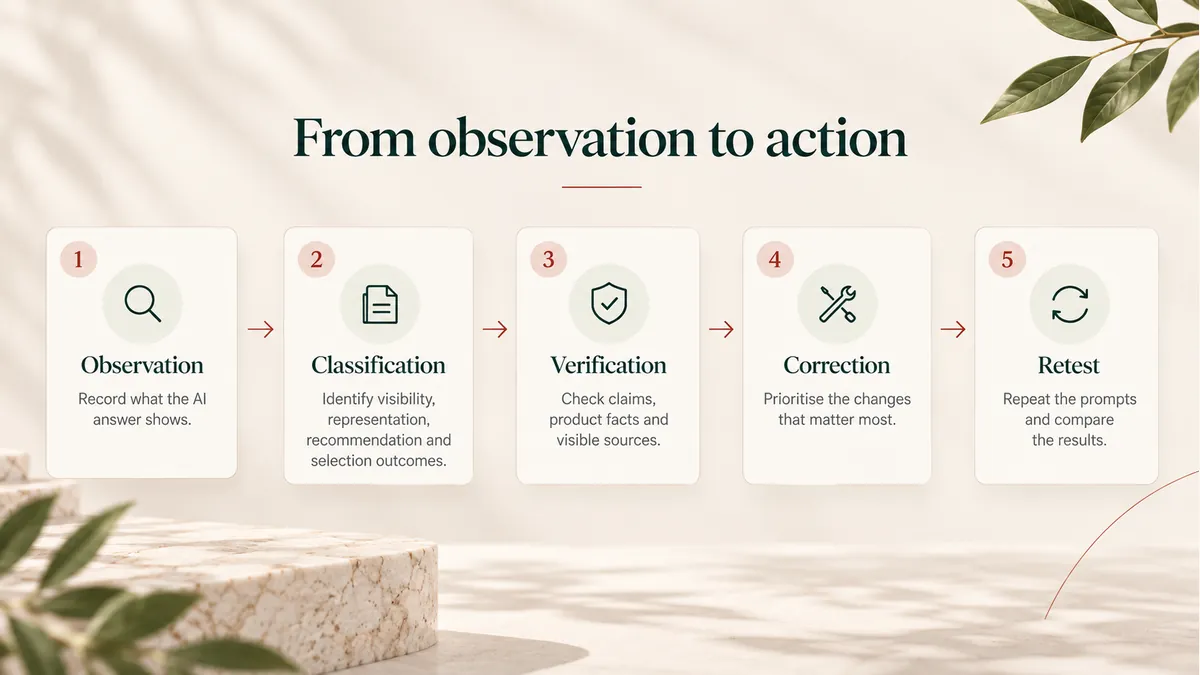
5. Correct the problems and measure again
5.1 Give each finding an owner and a completion check
For every important finding, record what happened, the evidence, the proposed correction, the owner and the retest.
| Field | Illustrative LUMEA finding |
|---|---|
| Observation | Two answers described the serum as fragrance-free |
| Checked fact | The checked ingredient list for the exact serum includes added fragrance |
| Conflicting information | An outdated retailer listing |
| Confidence | High confidence in the information error; uncertain effect on recommendation |
| Action | Correct the retailer listing and check related feeds |
| Owner | Ecommerce lead with product or regulatory support |
| Completion check | Correct information published in the identified locations |
| Retest | Repeat the original questions under recorded conditions |
| Outcome to measure | Claim accuracy, recommendation and purchase routing |
This gives the ecommerce lead a specific task and tells the audit team what to check after the correction.
View an illustrative product audit finding.
5.2 Prioritise the work
Address misleading claims, wrong products and unusable purchase routes before pursuing editorial opportunities.
For the remaining actions, assess:
- Impact: how important is the affected product or buying task?
- Confidence: how certain are you about the problem and proposed correction?
- Effort: what will implementation require?
A simple prioritisation formula is:
Define the rating scale your team will use and apply it consistently. The result helps order work; it does not predict commercial return.
Keep confidence in the error separate from confidence in a visibility improvement. You may know a listing is wrong without knowing whether correcting it will change recommendations.
5.3 Assign a realistic timetable
| Period | Focus | LUMEA examples |
|---|---|---|
| First 30 days | Correct existing information | Wrong variants, unsupported claims, feed errors and broken purchase links |
| Days 30 to 90 | Fill checked information gaps | Product explanations, local buying information and retailer consistency |
| Days 90 to 180 | Develop relevant evidence and repeat measurement | Legitimate expert coverage, independent testing where appropriate and ongoing monitoring |
Record external approvals and dependencies. A retailer correction is complete when the changed information is published, not when your team sends the request.
Editorial coverage also depends on another organisation's decisions. Keep it separate from updates your team can publish directly.
Use legitimate reviews, evidence and product claims. Do not manufacture reviews, buy unsupported endorsements or exaggerate benefits to seek recommendations.
5.4 Repeat the original tests
Before measuring again:
- Confirm the corrections are published and record their dates.
- Reuse the original questions.
- Use the same market and language.
- Match the interface and settings where possible.
- Repeat the observations.
- Record visible platform or model changes.
- Report newly added questions separately.
Compare the results by task.
| Measure | Before | After | Interpretation |
|---|---|---|---|
| Correct fragrance description | 1 of 3 | 3 of 3 | Accuracy improved in this sample |
| Positive recommendation | 1 of 3 | 1 of 3 | No observed recommendation change |
| Correct purchase link | 2 of 3 | 3 of 3 | Purchase routing improved in this sample |
The report shows which outcomes changed rather than treating the correction as a single success or failure.
Where practical, keep a comparable set of unchanged products or questions. Their results can help reveal platform changes affecting both the corrected and uncorrected parts of the audit.
A before-and-after improvement alone does not establish the correction caused it. Report the changes and any remaining uncertainty.
5.5 Give leadership a decision report
The executive report should let the CMO understand the findings and assign the next actions without reading every saved answer.
Include:
- Markets, interfaces, dates, questions and products tested.
- The most important findings.
- Results by customer task.
- Material product or claim errors.
- Source and retailer information gaps.
- Purchase-routing results.
- Corrections, owners and dependencies.
- Retesting dates and limits of the evidence.
Keep the complete answers, source records and detailed checks in the supporting spreadsheet.
5.6 Keep the scope of the findings clear
The audit shows how your brand and products appeared in the tested buying situations. It can establish whether descriptions were accurate, claims were supported and purchase routes were suitable.
It does not reveal every customer question, the assistant's hidden decision process or the frequency of those questions in the market. Incremental sales and completed purchases require separate evidence.
Use the audit to decide which information to correct and which buying situations to monitor.
When a more detailed audit is needed
This guide gives your team a starting point for understanding how AI systems find, describe and recommend your products.
A full Lex Agentica audit goes further. We investigate differences across AI platforms and European markets, examine where competitors are selected instead of your products, and assess how product information, claims and external sources relate to the observed answers.
The result is a documented assessment of findings that matter to your business, with prioritised recommendations, supporting evidence and a plan to measure what changes.
Next step
Get your audit baseline
Lex Agentica's AI Commerce Visibility Audit examines buying questions relevant to your business, product descriptions, visible evidence, recommendations and local purchase options.
You receive a documented baseline and a prioritised correction plan for your team.
Explore the AI Commerce Visibility & Selection AuditWe will discuss your priority markets, product categories and business objectives before defining the audit.
Frequently asked questions
Can we carry out the audit ourselves?
Yes. Your team needs access to the selected interfaces, current product records and time to collect, classify and check the answers. Assign an owner and involve product or regulatory colleagues where needed.
Can our visibility platform do the audit?
A platform can support collection, extraction and monitoring. Check what it covers. Your team still needs to confirm product facts, review ambiguous findings and decide which actions matter.
How many questions and repeat runs should we use?
Start with the suggested pilot and repeat the exact questions. Three fresh-session observations provide a first view of variation; they do not establish how every customer will experience the platform.
Does an omitted brand always indicate a problem?
No. First check whether the product meets the question’s requirements. Its absence alone does not explain why the assistant omitted it.
Do citations explain why a product was recommended?
They show visible sources associated with the answer. Check which claims they support. Citation frequency does not establish what caused the recommendation.
Can the audit demonstrate additional sales?
The audit measures the tested answers, product accuracy and purchase routes. Incremental sales and completed purchases require separate evidence.
For service scope, cost and implementation questions, see the audit page's FAQ.