
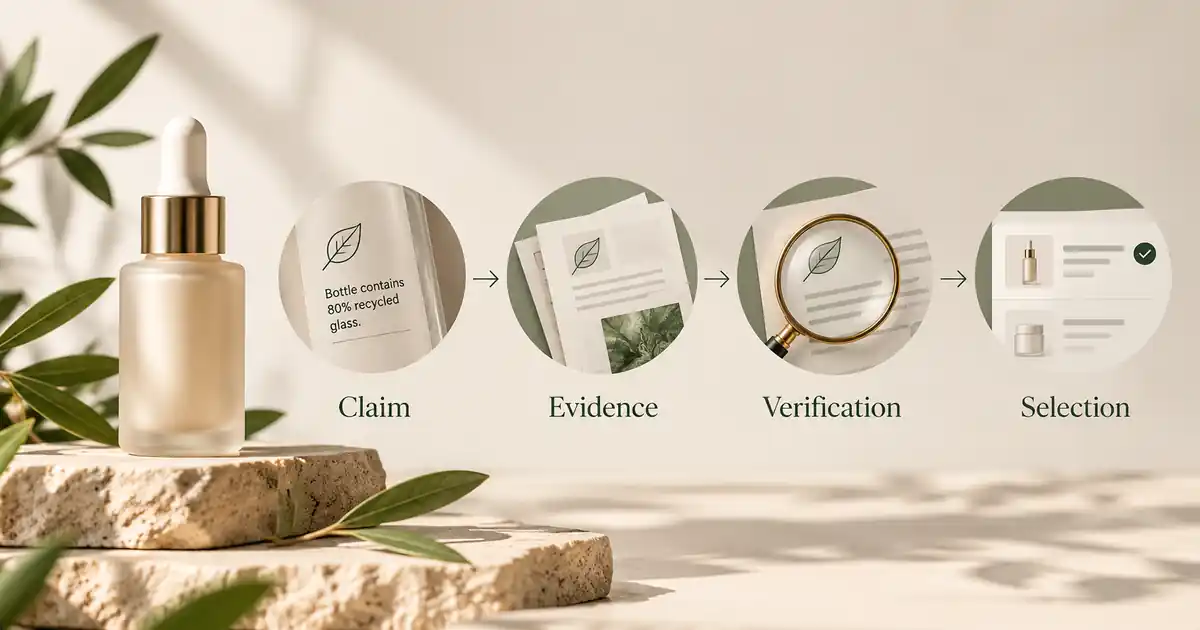
Beauty brands have spent years differentiating products through claims such as natural, organic, vegan, cruelty-free, recyclable and sustainable. From 27 September 2026, Directive (EU) 2024/825 on Empowering Consumers for the Green Transition, usually shortened to EmpCo and sometimes described informally as the EU greenwashing directive, changes the rules around some environmental claims and sustainability labels.
For beauty brands, that matters because these attributes often sit inside the product proposition and influence why a customer chooses one serum, cream or shampoo over another. Not every claim in that list is covered by EmpCo in the same way; the relevance depends on what is being claimed and how it is communicated. The Directive is also separate from the proposed EU Green Claims Directive.
At the same time, consumers are increasingly asking AI systems to recommend products using these same criteria.
That creates a new ecommerce question: if an AI system is asked to recommend a sustainable, vegan or natural product, what information does your brand need to make available for the product to remain a credible candidate?
Why should a beauty CMO or ecommerce leader care now?
- These attributes can influence product choice. Sustainability, packaging, certification and ethical product characteristics often sit inside the commercial proposition as well as the corporate sustainability programme.
- The regulatory environment is changing. EmpCo tightens the treatment of some environmental claims and sustainability labels from 27 September 2026.
- AI is already influencing shopping decisions. In a December 2025 McKinsey survey of 749 consumers in France, Germany and the United Kingdom, 38% said they had used AI tools in the previous three months to discover or decide on brands, products or services to purchase. Source
- The same product attribute can now be evaluated by several audiences. A customer, retailer, search engine or AI system may all encounter different versions of the claim.
The legal question matters. The commercial problem extends further: if product differentiation depends on a claim, the business needs to know whether that claim is specific, supported and usable wherever the buying decision happens.
What EmpCo changes in practical terms
For a beauty ecommerce team, three parts of the new framework are especially relevant:
- Broad environmental claims need more care. Terms such as ‘green’, ‘eco-friendly’ or ‘sustainable’ can fall within the rules on generic environmental claims.
- The scope of the claim matters. An environmental benefit that concerns the bottle, one ingredient or one activity should not be presented as if it necessarily applies to the whole product.
- Sustainability labels need a credible basis. EmpCo restricts sustainability labels that are not based on a qualifying certification scheme or established by a public authority.
There are important legal nuances behind each point, and beauty claims do not all fall into the same regulatory category. The primary legislation and Commission material are linked in the sources section below. This article is a commercial and ecommerce guide, not legal advice.
What could this mean for AI product recommendations?
EmpCo does not regulate how ChatGPT, Gemini, Claude or another AI system ranks products. Nor does compliance create a documented recommendation boost.
What changes is the information environment around some of the attributes consumers may use to shop.
Consider a customer asking:
Recommend a vegan face serum with sustainable packaging, available in Spain. I only want products whose environmental claims I can verify.
The shopper is making a buying decision.
To produce a useful answer, an AI system may need to establish whether the relevant attributes actually apply to the product, what a claim refers to, whether a certification covers the relevant product or component, and what information is available to support the recommendation.
Different AI systems retrieve and interpret information differently, so there is no universal evidence process. But a brand can control something more basic: whether the digital information around the product is coherent enough for an external system to understand what is being claimed.
This is closely related to a wider change I have written about before: AI-mediated commerce increasingly separates performed differentiation from proven differentiation. Sustainability is one of the clearest places to see that shift.
What beauty brands are getting wrong today
Often the evidence already exists, but the claim, the product and the proof have become disconnected from one another.
1. Turning a specific fact into a broad product claim
Imagine that a brand can demonstrate that a serum bottle contains 80% post-consumer recycled glass. That is useful product information.
Broad conclusion. Unclear scope. The evidence may concern only one part of the product.
Specific fact. Clear scope. The supporting evidence can be connected directly to the bottle claim.
The first habit to challenge is simple: do not let the wording travel further than the evidence.
2. Letting one certification carry the whole sustainability story
A valid certification proves whatever that certification actually covers. A vegan certification may substantiate vegan status. Packaging evidence may support a packaging statement. A company-level certification may say something useful about the business.
None of those automatically proves that the entire product is ‘sustainable’.
The better question is: what exactly does this certification allow us to say about this SKU?
3. Burying the evidence somewhere else
The PDP says ‘sustainable packaging’. The corporate website explains the sustainability strategy. The supporting document is hidden inside a PDF. The certification sits on somebody else’s website. The methodology is known by the sustainability team.
The customer has to reconstruct the relationship between all of them.
Don’t just publish evidence. Connect the environmental claim to the evidence at the point where the customer encounters the claim.
The product page only needs enough information to make the relationship clear: what are you claiming, what does it apply to, what supports it and where can I check it?
4. Allowing the claim to change between channels
A brand may carefully write ‘bottle contains 80% post-consumer recycled glass’ on its own PDP, while a retailer or marketplace turns it into ‘eco-friendly sustainable serum’. Packaging may contain another version. Older campaign material may carry still more.
That is more than inconsistent messaging. It creates multiple versions of the product truth.
5. Treating evidence as documents rather than product information
Certificates, test reports and methodologies often exist as files owned by different departments. That may be sufficient internally. It is much less useful when the commercial question is: does this evidence support this claim, about this product, in this market, now?
That relationship increasingly belongs in the product-information layer, so teams do not have to reconstruct it manually every time somebody asks a difficult question.
What marketing and ecommerce teams should change now
Start with the claims that matter commercially. A full redesign of the product-data architecture can come later if the evidence shows it is needed.
- Identify the claims that influence product choice. Start with priority products and the attributes customers actually use when comparing them. Do not begin by cataloguing every sustainability sentence the company has ever published.
- Define the scope. For each claim, ask whether it refers to the formulation, one ingredient, the bottle, the carton, a production site, a sourcing practice, the company or the whole product.
- Connect the claim to the evidence. Give the customer enough information on the PDP to understand the statement and provide access to deeper evidence where appropriate.
- Check the other places where the product is sold. Review priority marketplaces, retailer listings, packaging, product feeds and campaign landing pages. The same product fact should not become progressively broader as it moves through the commerce stack.
- Make approved information reusable. Once the claim is properly defined, approved and connected to evidence, make it available through the PIM, CMS, retailer feeds and other appropriate product-data systems.
For the recycled-glass example, a better PDP might say:
This is less expansive marketing. It is better product information.
The sequence matters: get the claim right first. Distribute it second. Structured or machine-readable data can help distribute approved facts, but it cannot turn a weak claim into a substantiated one.
Who owns this internally?
No single team owns the whole problem. The useful operating model is to move the evidence upstream, before the claim is distributed.
Marketing and brand decide which attributes matter commercially. Product, regulatory, sustainability or R&D establish the factual basis. Legal and compliance determine supportable wording. PIM, product-data and ecommerce teams turn the approved claim into reusable product information. Marketplace, SEO and content teams preserve its meaning across channels, while data and technology support machine-readable distribution where there is a real use case.
The organisational change is straightforward:
Evidence first → approved claim → product truth → distribution.
That is a better model than marketing writing an ambitious claim first, legal approving it at the end and every downstream channel publishing its own version.
What Lex Agentica is testing
While testing AI visibility and product selection across European beauty brands, I started seeing environmental claims, certification and greenwashing enter recommendation answers even when the main task was simply to choose a product.
In some buying situations, AI systems introduced warnings about greenwashing, explained how a certification or claim could be checked, or referred to the changing EU rules around environmental claims. I did not treat those answers as proof of how recommendation mechanisms work. They gave me a research question worth testing against actual recommendation behaviour.
Do stronger regulatory and evidence requirements change which beauty products AI systems consider, qualify or recommend?
The analysis is still in progress. I am therefore treating this as a hypothesis to test. The analysis does not yet show that EmpCo changes AI rankings or that compliant brands will automatically be recommended.
If regulation changes the evidence environment around an attribute customers use to choose, and that same attribute influences an AI-generated consideration set, the commercial effect deserves to be measured.
A simple mention tells you very little. The commercial question is whether the system understands the product correctly and whether it remains a credible candidate when the shopper adds the criteria that matter to the purchase.
For a broader view of how recommendation systems can differ across platforms, see AI Product Recommendations: How Ecommerce Brands Can Improve AI Visibility.
One question I would ask the team now
If I were a CMO or Chief Digital Officer at a beauty brand, I would start with one question:
‘Show me the evidence behind every environmental claim on our priority product pages.’
I mean the evidence behind the actual commercial claims, rather than the campaign or the sustainability presentation.
If answering that requires a 30-minute explanation, five PDFs and a sustainability manager joining the call, the problem is bigger than copy. The product-information architecture is requiring somebody outside the organisation to reconstruct an argument the brand should already have made clear.
For beauty brands selling across the EU, sustainability now reaches well beyond brand storytelling. It is increasingly connected to product information architecture, regulatory compliance, SEO, marketplace content, data strategy and AI discoverability and selection.
The opportunity is to become much better at proving what green means for a specific product.
EmpCo gives European beauty brands a regulatory reason to improve that discipline. AI-mediated shopping gives them a commercial one.
Getting the claim right serves the customer first. It also gives AI systems clearer information to work with when that claim becomes part of the buying criteria. That does not guarantee recommendation, but it removes one source of ambiguity between what the brand says, what the evidence supports and what an external system has to interpret.
Don’t make your product look more sustainable. Make its environmental claims easier to verify.
What happens when those claims become part of an AI buying decision?
If environmental, certification or other product claims help differentiate what you sell, the next question is whether AI systems find and interpret those attributes correctly when a customer uses them to choose.
Lex Agentica’s AI Visibility Snapshot tests one priority buying situation and gives you one bounded finding with a practical next step.
Frequently asked questions
Does EmpCo apply to every beauty claim such as vegan, natural or organic?
No. These claims do not all fall under EmpCo in the same way. EmpCo is particularly relevant to environmental claims and sustainability labels, while cosmetics claims also sit within existing EU evidential rules. The exact treatment depends on what is being claimed and how it is communicated.
Does complying with EmpCo make an AI system more likely to recommend my product?
There is no evidence for a general ranking rule of that kind. Compliance does not create an automatic recommendation boost. The more useful commercial point is that specific, consistent and verifiable product information gives an AI system clearer information to work with when the relevant attribute forms part of the customer’s buying criteria.
Does every environmental claim need independent third-party certification?
It depends on the claim. EmpCo contains specific requirements for particular practices such as sustainability labels, while other claims may rely on different forms of substantiation. From a commercial perspective, the important questions are whether the claim is specific, whether the evidence covers its scope and whether the basis of the claim can be checked.
Where should product evidence live?
The customer should be able to understand the essential claim where they encounter it. Deeper evidence can sit in a dedicated product-level record or supporting page. The same core product truth should then survive on marketplaces, retailer listings and packaging.
Should we put all our sustainability documentation on the PDP?
No. The objective is clarity. The PDP should explain the claim sufficiently for the customer to understand what it means and provide access to further evidence where appropriate.
Is this mainly a legal or sustainability-team responsibility?
No. Legal and sustainability teams are important, but the claim ultimately travels through marketing, ecommerce, product data, marketplaces, SEO, packaging and other channels. The operating problem is cross-functional.
Do we need new AI-specific technology to solve this?
Start with the underlying product information: accurate claims, defined scope, appropriate evidence, approved wording and consistency across channels. Once that foundation exists, structured and machine-readable distribution can make approved information easier for external systems to retrieve.