
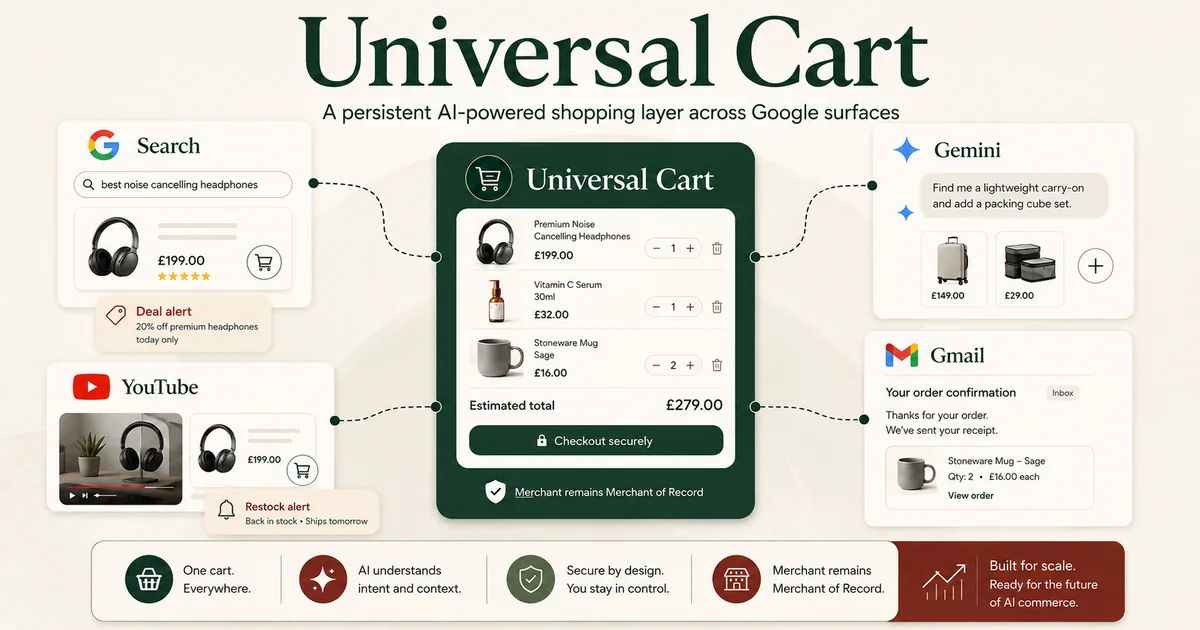
More of the customer journey can now happen outside your website. That changes what ecommerce teams need to prepare.
Google’s Universal Commerce Protocol, or UCP, creates a common way for AI shopping experiences, merchants and payment systems to exchange the information needed for product discovery, cart creation, checkout and order handling. Universal Cart makes that more visible to the customer by keeping shopping activity connected across Google products.
For European ecommerce leaders, the useful question is not simply what UCP is. It is what needs to be ready before these flows become more widely available in Europe: product data, Merchant Center, checkout rules, customer-data controls, internal ownership and governance.
What senior leaders need to know
- The buying decision is moving into AI shopping flows. Customers can discover, compare and build a cart across Search, Gemini, YouTube and Gmail before they reach your website.
- Being the Merchant of Record does not mean controlling the decision. The merchant stays the legal seller while AI systems shape the shortlist, the comparison and the path into checkout.
- Product data and claims become a leadership issue. What AI systems can read about price, availability, attributes and claims decides whether a product is shown, trusted and selected.
- European preparation can start before availability. Product data, claims, Merchant Center quality, checkout rules, consent and ownership can all be checked now.
The useful distinction is between being ready and being live. A feature does not need to be available to every European consumer before it matters to a European retailer.
What Google Universal Cart is
Universal Cart is Google’s shopping cart for use across merchants and across Google services. Google announced it on 19 May 2026 and is rolling it out on Search and the Gemini app in the US, with YouTube and Gmail to follow. Google, 19 May 2026
A shopper can add products from several retailers while searching, chatting with Gemini, watching YouTube or reading Gmail. The cart then works in the background: it tracks price drops and price history, flags when items are back in stock and warns about incompatible products. Because it is built on Google Wallet, it can also take payment perks and loyalty information into account.
At checkout, the shopper can pay with Google Pay in a few taps or transfer the cart to the merchant’s own site. Google says the brand remains the merchant of record either way. The checkout runs on UCP, which is why the two are easy to confuse: Universal Cart is what the shopper sees, and UCP is the protocol underneath.
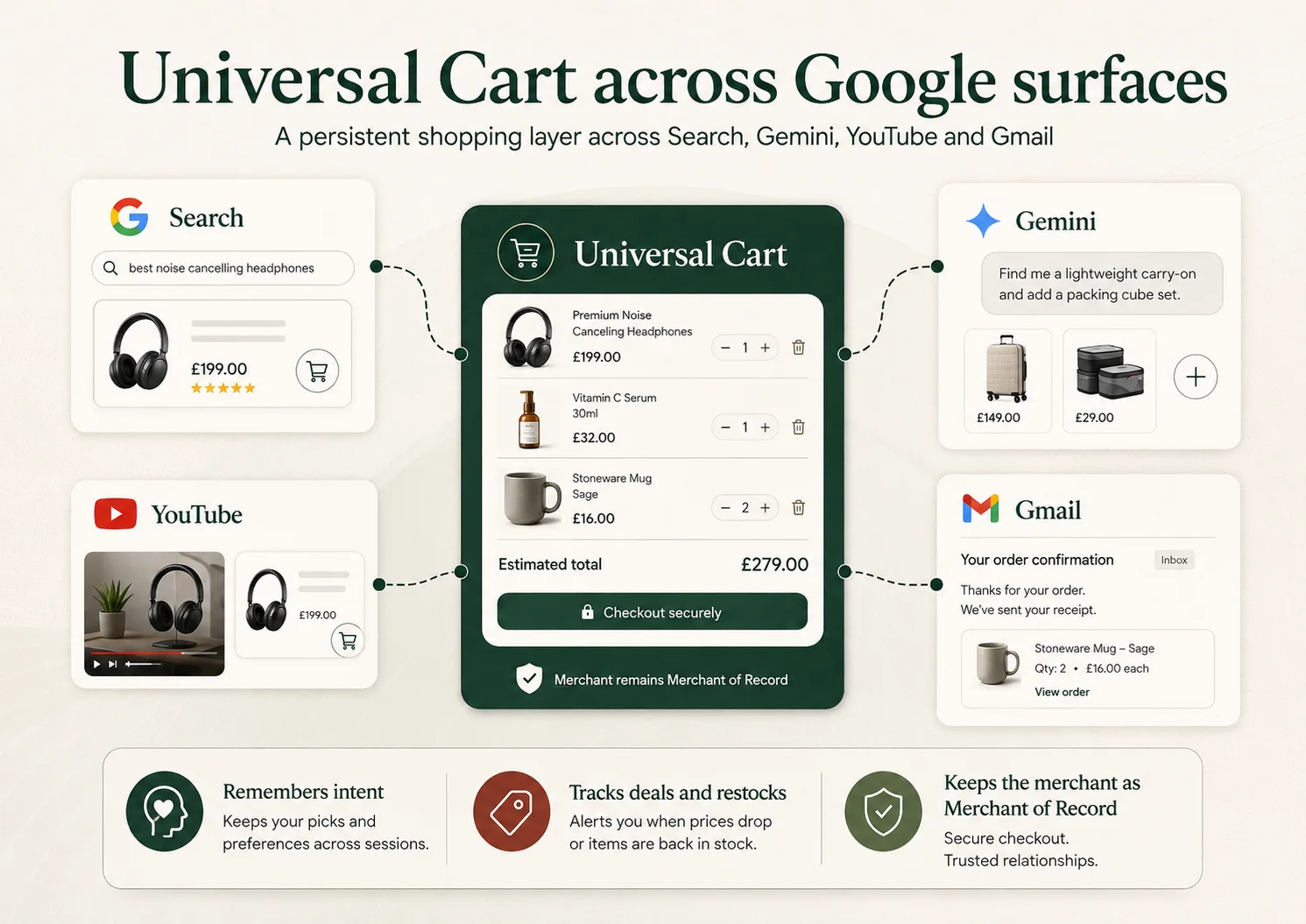
The merchant may still own the transaction, fulfil the order, handle returns, maintain the customer relationship and remain Merchant of Record. But more of the journey connecting discovery, comparison and purchase may happen outside the merchant’s own website.
What UCP actually does
UCP is easy to overcomplicate. It is not a website feature, a checkout button or a switch that makes a company ‘agentic commerce ready’.
It is a commerce protocol: a shared set of rules that allows different systems to exchange the information needed to support shopping and checkout. Google describes it as an open standard for agentic commerce that enables agents and systems to work together across the commerce ecosystem. Google UCP overview
Commercially, UCP helps systems answer questions such as:
- Is this product available?
- Is the correct variant available?
- What is the current price?
- Can this product participate in a particular checkout flow?
- Which shipping and fulfilment options apply?
- Which policies or restrictions need to be shown?
- How should the cart be handed to the merchant?
- How should an order be completed?
- How does the merchant remain responsible for the transaction?
That is why UCP matters beyond the technical team. Another system needs to be able to read your commerce information and use it correctly.
In business language, four functions matter most.
1. Cart transfer
An AI shopping experience can prepare a cart and transfer the customer to the merchant’s own site to complete the purchase.
Business question: can your site reliably receive the right products, variants, quantities and prices from an external journey?
2. Native checkout
For participating merchants, a supported AI surface can manage more of the checkout journey while the merchant remains responsible for the underlying transaction and order.
Business question: can your checkout rules work reliably when the journey starts outside your website?
3. Identity and account linking
Google’s Merchant Center UCP hub includes identity linking as one of the capabilities merchants can select.
Business question: what customer, loyalty or account information should be accessible through an external AI interface, and who approves that access?
4. Fulfilment and order logic
Availability, shipping, tax, returns, discounts and other rules need to work consistently when another system interacts with your commerce systems.
Business question: do the rules that work on your website still work when the customer journey starts somewhere else?
The practical change is that more of checkout can now happen through structured system-to-system interactions.
UCP, ACP and AP2: which rails matter
UCP is Google’s rail for agentic commerce, but it is not the only one. For a European leader, the useful question is not which protocol to build first. It is which customer journeys matter to the business, and which rails those journeys run on.
ACP: OpenAI’s route to checkout
OpenAI’s Agentic Commerce Protocol (ACP), developed with Stripe, powers checkout inside ChatGPT. It launched first in the US. If your customers research in ChatGPT as much as in Google, ACP is the parallel rail to watch.
AP2 and payment trust
UCP covers how commerce systems interact. Google’s Agent Payments Protocol, AP2, addresses a different but related problem: how an AI-assisted payment can be authorised and recorded so it can be checked later. Google describes AP2 as an open protocol designed to create a common language for secure, agent-led payments. Google Cloud AP2 announcement
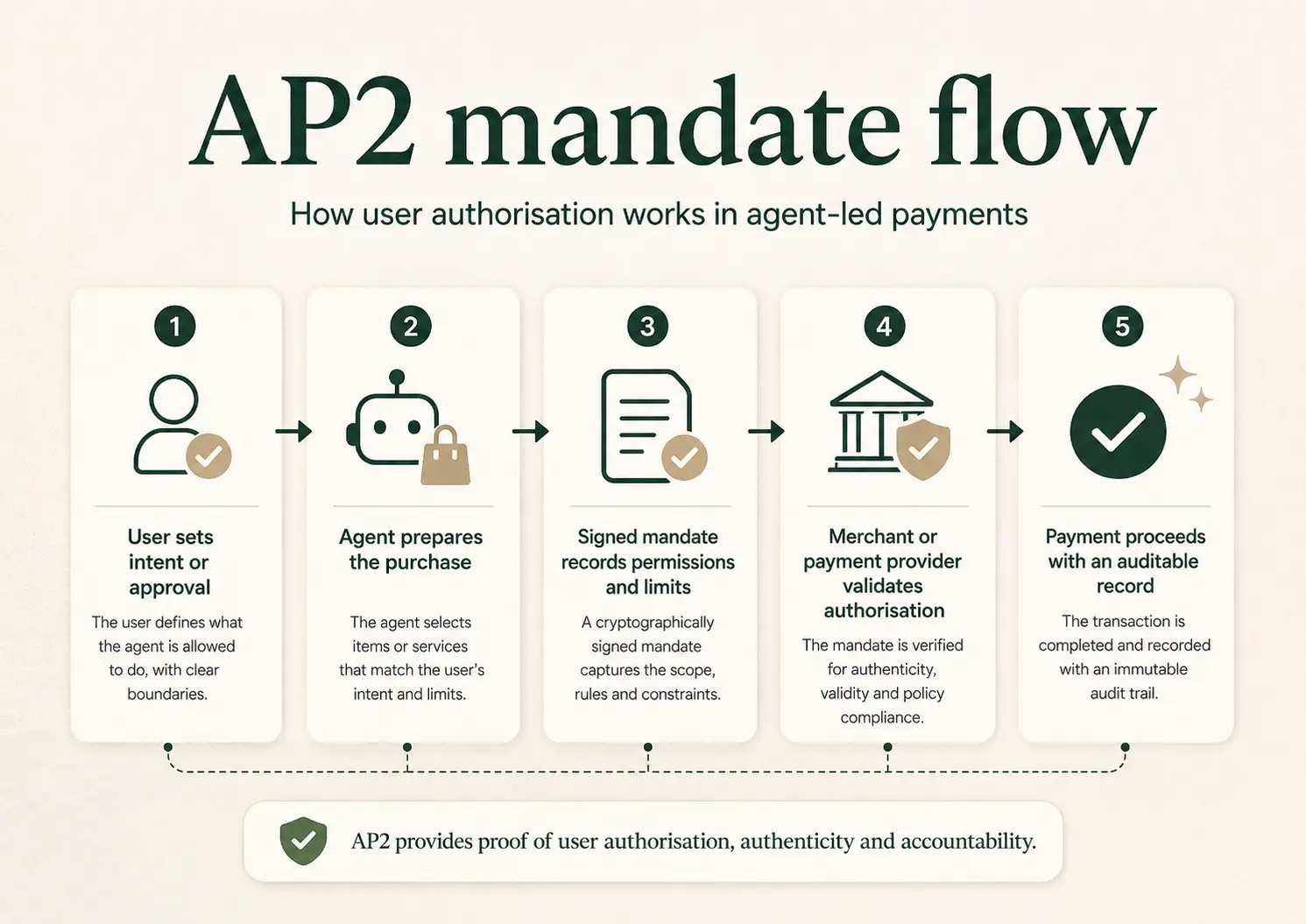
The important point is not the protocol name. AI-assisted payments need more than convenience. Customers, merchants, payment providers and regulators need clear evidence of who authorised the payment and who is responsible.
For European organisations, this matters when payment, identity and customer data begin to move through AI-assisted commerce systems.
The preparation is the same for every rail: product data, claims and policies that machines can read and trust; checkout rules that still work when the journey starts elsewhere; and clear ownership of which channels are switched on. That work carries over, whichever protocol reaches your market first.
From click to buy to intent to order
Traditional ecommerce was built around a familiar sequence:
AI-assisted commerce begins earlier, with intent.
A customer may ask an AI system to compare options, find a product that meets specific requirements, check compatibility, remember preferences, monitor prices or prepare a purchase before they ever visit the merchant’s website.
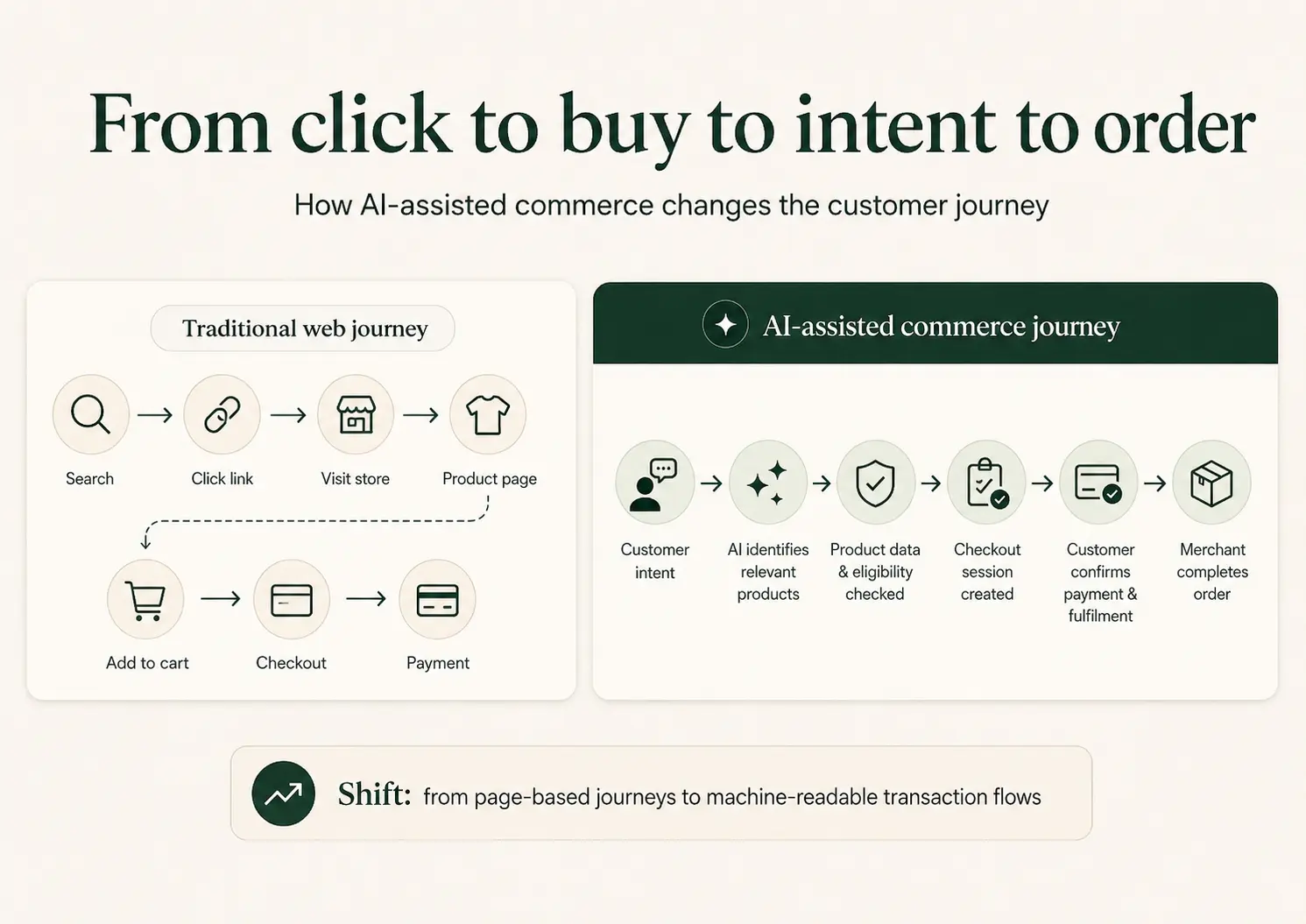
The emerging journey looks more like customer intent → AI identifies products → products are compared → price and availability are checked → cart or checkout is prepared → customer confirms → merchant fulfils the order.
The change is not simply from one interface to another. More of the journey now depends on systems exchanging structured product, cart and checkout information.
In the old model, the brand gained more control once the shopper reached its website. In the new model, a larger part of the decision context may be created before that happens.
What this changes for marketing across the buyer journey
For a marketing or ecommerce leader, the practical question is not whether the journey is changing. It is what changes at each stage, and what the business needs to do differently.
Awareness
Traditional awareness work is built around paid media, organic search, social, PR and content.
In AI-assisted product discovery, some of that awareness now happens inside AI answers and shopping experiences. A customer asks a question and the system decides which brands or products are relevant enough to show.
That makes a new question important: Can the system understand what you sell, who it is for and why it is relevant?
For Google specifically, Merchant Center is becoming more important because it supplies product information to Google’s AI shopping experiences. Shopify’s current Google documentation says product discovery in Google AI Mode and Gemini is powered through the Google & YouTube sales channel, which syncs product and store information to Merchant Center. Shopify documentation
Consideration
In a traditional journey, the brand can devote substantial effort to product pages, comparison guides, reviews and persuasive content.
In an AI-assisted journey, the system may perform much of that comparison for the customer. It can summarise options, surface competitors, explain trade-offs and recommend products.
The brand’s content still matters, but it now has two jobs. It must persuade the customer directly and give AI systems enough accurate, consistent and credible information to describe the product correctly elsewhere.
What that means for positioning is covered in how to keep brand differentiation in AI-mediated commerce.
Conversion
Conversion no longer starts only on the checkout page.
Google’s Merchant Center UCP hub distinguishes capabilities such as cart transfer, native checkout and identity linking. Shopify makes a similar commercial distinction: eligible merchants can keep Google AI Mode and Gemini direct checkout active or turn it off while products remain discoverable and customers are redirected to the merchant site. Merchant Center UCP hub Shopify documentation
That means product identifiers, price, availability, shipping, policies and checkout rules become part of checkout readiness.
Retention
Retention introduces a different question.
Traditionally, loyalty and repeat purchase live mostly inside the brand-customer relationship: email, account, app, CRM and direct channels. AI-mediated commerce adds another interface between the two.
The question is not only whether an AI system can help generate another sale. It is also what customer, loyalty and account information should be shared, under what conditions, and which parts of the post-purchase relationship should remain under the merchant’s control.
The existing marketing funnel still matters. The difference is that an AI system can now influence several stages of it.
Merchant of Record does not mean control of the decision
Merchants still play a central commercial role, but legal ownership of the sale and control of the customer journey are not the same thing.
A brand can remain Merchant of Record while an AI system influences which products make the shortlist, how they are described, which competitors appear, which attributes are emphasised and whether the customer continues to the merchant’s website or another interface.
The customer still confirms the purchase
Agentic commerce does not mean customers disappear from the transaction. Current implementations still keep people involved in sensitive fulfilment and payment steps. Shopify’s Google AI Mode and Gemini flow, for example, lets customers enter shipping and payment information and confirm the purchase inside a Shopify-powered direct checkout. Shopify documentation
The immediate change is that AI systems are shortening the distance between discovery, comparison, cart creation and checkout. That matters because brands have traditionally used this part of the journey to influence customers through merchandising, content, offers, product detail and experience design.
The customer may still confirm the purchase. But more of the information and comparison leading to that decision may be shaped elsewhere.
Why product data becomes a leadership issue
In traditional ecommerce, product data quality was often treated mainly as a feed-management problem.
In AI-assisted commerce, it becomes part of whether products can be understood and used correctly.
Google’s Merchant Center UCP documentation says Merchant Center remains the central hub for preparing product data and can alert participating merchants when feed attributes, returns or account configuration need attention. Merchant Center UCP hub
Google has also introduced optional conversational attributes intended to help AI systems and conversational agents understand product nuances. These include question-and-answer data, document links, related products, item-group titles, variant options and popularity rank. Conversational attributes
This does not mean adding more fields automatically makes a product more visible or more likely to be recommended.
It means AI commerce increasingly depends on product information that is structured, consistent and detailed enough to use.
A mismatch between the website, Merchant Center, checkout rules and retailer data can become more than a feed problem. It can affect whether a product is understood, shown correctly or able to move towards purchase.
The Merchant Center foundation
This is where AI visibility and agentic commerce begin to overlap. For Google, Merchant Center is no longer only a Shopping feed destination. It increasingly supplies structured product information to Google’s AI shopping experiences.
Google’s AI Performance Insights report provides data on conversational shopping visibility, including share of voice, competitors, products showing, search intent and shopping stages. Since 16 September 2026 it has been generally available in Australia, Canada, India, New Zealand and the US. No EU country is included, so European brands cannot yet use it as a cross-market measurement layer. AI Performance Insights Google, 16 September 2026
That changes the order of the work. Inside Google, AI visibility and Merchant Center are increasingly connected, so the question is not simply which one to work on first.
But it is important not to overstate the relationship. Strong Merchant Center data does not guarantee recommendation or visibility across every AI system. It does mean that, inside Google’s own commerce environment, product data quality is part of whether Google can interpret and act on the catalogue correctly.
For how products gain or lose recommendations across assistants, see how ChatGPT, Gemini and Claude recommend products.
From visible to selected
Visibility used to mean appearing in search results, shopping listings, ads or marketplaces. In AI-assisted commerce, that is only the first stage.
A product can appear and still be described incorrectly. It can be represented correctly and still lose to a competitor. It can be recommended and still be unable to progress into checkout.
This is why product data, claims, evidence and checkout readiness need to be considered together.
For UCP specifically, visibility is not only about being found. The product and checkout information also need to be reliable enough to support the next step.
Lex Agentica’s AI commerce visibility audit tests the first stages of this sequence, whether products are visible, represented correctly, recommended and selected, for a brand’s priority products and markets.
Why EU beauty brands should watch this
Beauty is visible in Google’s first wave of agentic checkout. When Google announced Universal Cart, it named Sephora, Ulta Beauty and Fenty among the merchants for its new checkout features in the US. Google, 19 May 2026
For European beauty brands, that is an early signal rather than a deadline. It shows the kind of retailers in Google’s first wave, and what they must supply: accurate product data, clear policies and checkout rules that still work when the journey starts somewhere else.
Claims make beauty harder. Efficacy, ingredient and sustainability claims travel with the product into AI answers and carts, and new EU rules on environmental claims have applied since 27 September 2026. Claims that are consistent across the brand’s own site, Merchant Center and retailers give AI systems less contradictory information to work from.
For evidence on how AI systems find, describe and recommend European products, see Lex Agentica’s research on AI product recommendations.
What is different for European brands
Europe is not simply a later market. Three things make preparation different here: large retailers are moving before consumers can buy, governance obligations apply whatever the protocol, and measurement gets harder as the journey leaves your website. Google has not given a reason for the EU timing. Explanations that point to the Digital Markets Act or data-protection rules are interpretation, not something Google has stated.
European retailers are already preparing
For Europe, two facts need to stay separate. Retailers can prepare for UCP before UCP checkout is widely available to consumers. Carrefour and Zalando are examples of preparation, not proof of broad consumer availability.
Carrefour’s strategic plan describes a Google partnership to co-create a shopping experience directly from Gemini using UCP. Zalando has described itself as one of two European launch partners for Google’s Universal Commerce Protocol. Carrefour 2030 Zalando results
Neither example proves that UCP checkout has become a mainstream European commerce channel.
What they show is that large European retailers are willing to prepare before widespread consumer rollout.
Governance, consent and accountability
UCP can make commerce flows more structured, but it does not resolve GDPR, consumer-law, Digital Markets Act, AI governance or accountability questions by itself.
Those obligations depend on how the company uses the technology, what data moves between systems, how recommendations and customer information are handled, and who is responsible when something goes wrong.
This is one of the reasons a US implementation cannot simply be treated as a European operating model.
Account-linked and persistent shopping journeys make this concrete. Before enabling them, decide which customer, loyalty and consent data may move between an AI surface and your systems, on what basis, and who approves it.
Measurement
As more of the journey happens before a website visit, traditional analytics becomes less complete.
Shopify notes that Google Analytics and custom client-side pixels do not fire inside Google AI Mode and Gemini direct checkout; only server-to-server checkout events are supported there. Shopify documentation
That means someone needs to own measurement beyond normal website analytics.
Consumer behaviour
It is not yet clear how quickly consumers will move from using AI for research and comparison to trusting it with more of the purchase journey.
That will vary by category. Delegating a low-risk repeat purchase is different from buying skincare with sensitive claims, choosing a high-value product or making a decision with safety implications.
Is this relevant to your brand right now?
Not every European brand needs to build a UCP integration in the next 90 days. The answer depends on three questions.
1. Is your category already active in AI-mediated shopping?
Run a small, repeatable set of customer-style buying queries across the categories that matter most commercially.
Do not only record whether your brand appears. Check whether the product is represented accurately, which attributes are used, which competitors appear, whether your product is recommended or substituted, and whether results vary between repeated runs.
Treat this as a first indication, not as a full visibility benchmark.
2. Are your competitors preparing?
Look beyond announcements. Check whether competitors are improving product data, joining agentic-commerce partnerships, testing AI shopping or changing how they structure commerce information.
One competitor announcement is not enough to create urgency. Look for a pattern before deciding that your category is moving faster than your internal plans.
3. Is your product data ready anyway?
This is the safest place to start. Strong product data, clear claims, consistent attributes, reliable identifiers, accurate availability and clearly structured policies are valuable whether or not UCP becomes a near-term priority.
If those areas are weak, fixing them will still improve the business even if UCP takes longer to reach Europe.
What EU commerce leaders should do now
Do not start with a large technical project. Start with the products and categories that matter most commercially.
- Test how your products appear in AI. Check whether Google’s AI experiences understand your products, use cases and differentiators correctly. Record missing products, incorrect descriptions, weak matches, competitor substitutions, unsupported claims and important differences between repeated runs.
- Check Merchant Center and product data. Review titles, descriptions, identifiers, variants, availability, price, shipping, returns, imagery, category information and conversational attributes where relevant. Check for differences between the website, Merchant Center, structured data and retailer listings.
- Check product claims and evidence. This is particularly important for European consumer brands where sustainability, efficacy, safety, origin, certification or technical performance influence selection. Check whether important claims are precise, supported, consistent and easy to verify.
- Check checkout readiness. Review cart transfer, native checkout, fulfilment rules, product-ID consistency, policies and customer-data handling. Not every brand needs all of this now, but leadership should know where the gaps are.
- Define ownership and controls. Decide who owns agentic-commerce channels, who can turn them on or off, who approves checkout participation, which products can participate, how customer data may be used, how analytics are handled and who is responsible when the AI journey behaves differently from the website.
Before any AI commerce channel is switched on, the leadership team should be able to answer six questions:
- Who knows the channel is active?
- Who approved it?
- Which products are eligible?
- What customer data is involved?
- What happens to analytics, consent and checkout customisations?
- Who owns the decision to opt out?
Those are not abstract future questions. Some merchants already need to answer them.
Four areas to check
The work can be organised into the four areas of Lex Agentica’s agentic commerce readiness model.
Visibility
Question: Can Google’s AI surfaces understand what you sell, who it is for and when it is relevant?
Risk: Your products are absent, misunderstood or substituted.
Data integrity
Question: Are product details, claims, policies, identifiers and availability consistent across channels?
Risk: AI systems may become more cautious, describe the product incorrectly or rely on weaker third-party information.
Capability
Question: Can your commerce systems support cart and checkout flows started by another system?
Risk: The product may be visible but still fail when the customer tries to move towards purchase.
Governance
Question: Who decides what an AI commerce channel can see, say, start or buy from your business?
Risk: New AI commerce channels can move faster than your internal ownership and controls.
That is the work now. UCP does not need to be fully available across Europe for product data, checkout, ownership and controls to matter.
Assess your AI commerce visibility and readiness
Lex Agentica helps European ecommerce teams test whether products are being found, described and selected correctly, then connect those findings to product data, commerce capability and governance priorities.
The commercial bottom line
The website, brand, SEO, Merchant Center, retail media, content and performance marketing still matter. The change is that more of the customer’s decision can happen somewhere else before the website visit.
For European ecommerce leaders, UCP is neither a reason to ignore the change nor a reason to rush into a large implementation. It is a reason to check whether product data, checkout, ownership and controls are ready for a different buying journey.
The useful questions are simple: Can AI systems understand our products correctly? Are our claims and product data reliable enough to support recommendation? Can our commerce systems support new checkout paths? Do we know who controls those paths when they become available?
Those are the gaps European ecommerce teams can start checking now.
Status tracker: Universal Cart and UCP by market
This tracker records what Google and Shopify have announced for each market, taken from their own posts and documentation. A market changes status here only when an official source changes. Agency and press claims appear separately in the status log.
| Market | Universal Cart for shoppers | UCP-powered checkout on Google | Merchant Center tools |
|---|---|---|---|
| United States | Rolling out on Search and the Gemini app from summer 2026, with YouTube and Gmail to follow. | Live. Google says UCP enables direct checkout for hundreds of thousands of brands and retailers. | UCP hub cart transfer and checkout testing rolling out. AI performance insights available. |
| Canada and Australia | Not announced. | Announced in May 2026 for ‘the coming months’. | UCP hub capabilities from early 2027. AI performance insights available. |
| United Kingdom | Not announced. | Announced in May 2026 for ‘later this year’. Not live yet. | Not announced. |
| EU member states | Not announced. | Not announced. | Not announced. |
Last verified . Google’s Wallet Help says Universal Cart is currently available only in the United States. AI performance insights in Merchant Center is also available in India and New Zealand. On Shopify, eligible stores are in the US, UK, Australia and Canada, and direct checkout in AI Mode and Gemini is shown only to US customers. Google Wallet Help Google, 19 May 2026 Google, 16 September 2026 Shopify documentation
Merchant eligibility, product discovery and customer checkout availability are three different things. A brand can be eligible to sell and its products can be discoverable while its customers still cannot check out inside an AI experience.
What has changed since May 2026
When this guide was first published in May 2026, UCP could still be described mainly as an emerging protocol. Google now runs a Merchant Center UCP integration hub where merchants can validate their UCP profile, cart transfer and native checkout, and in September it added cart transfer to the merchant’s site and enhanced checkout-flow testing. Shopify has moved Google AI Mode and Gemini into its Agentic Storefronts, with direct checkout active by default for eligible stores and shown only to US customers. Each change is dated in the status log below. Merchant Center UCP hub Google, 16 September 2026 Shopify documentation
Status log
Every change to the status above, newest first. Dates are the source’s publication date. Third-party claims are listed as reported and do not change a market’s status until an official source confirms them.
| Date | What changed | Where | Status and source |
|---|---|---|---|
| 16 Sep 2026 | Cart transfer to the merchant’s site and enhanced checkout-flow testing added to the Merchant Center UCP hub. Analytics ‘coming soon’. | US now; Canada and Australia early 2027 | Rolling out. Google |
| 16 Sep 2026 | AI performance insights made generally available. | US, Canada, Australia, India and New Zealand | Live. Google |
| By Sep 2026 | Merchant Center Help documents the UCP integration hub, with a sandbox to validate the UCP profile, cart transfer and native checkout. Onboarding rolling out gradually. | US now; Australia and Canada in 2027 | Rolling out. Merchant Center Help |
| 20 May 2026 | Google’s business announcement says UCP-powered checkout reaches Canada and Australia ‘soon’ and the UK ‘later this year’. | Canada, Australia, UK | Announced. Google |
| 19 May 2026 | Universal Cart announced, rolling out on Search and the Gemini app ‘this summer’, with YouTube and Gmail to follow. | US | Announced. Google |
| 19 May 2026 | UCP-powered checkout to expand to Canada and Australia ‘in the coming months’, then to the UK ‘later’. | Canada, Australia, UK | Announced. Google |
| 19 May 2026 | Nike, Sephora, Target, Ulta Beauty, Walmart, Wayfair, Fenty and Steve Madden named for checkout features ‘soon’. | US | Announced. Google |
| Early 2026 | Zalando describes itself as one of two European launch partners for UCP. | Europe | Partner preparing. Zalando |
| Feb 2026 | Carrefour’s strategic plan describes a Google partnership to co-create a shopping experience directly from Gemini using UCP. | Europe | Partner preparing. Carrefour |
| Undated | An agency report describes a phased UK release of UCP-powered checkout during mid-2026. | UK | Reported. Not confirmed in Google’s own posts. |
Last verified .
FAQ
What is Google Universal Cart?
Universal Cart is Google’s shopping cart that works across merchants and across Search, the Gemini app, YouTube and Gmail. It tracks prices and stock, flags incompatible items, and lets shoppers pay with Google Pay or transfer the cart to the merchant’s site. The brand remains the merchant of record.
Is Universal Cart the same as UCP?
No. Universal Cart is the shopper-facing cart. UCP, the Universal Commerce Protocol, is the open standard underneath it. It lets AI surfaces and merchant systems exchange product, cart and checkout information.
What is UCP in simple terms?
UCP, or Universal Commerce Protocol, is an open commerce standard that allows AI surfaces, merchants and related commerce systems to exchange the information needed to support AI-assisted shopping and checkout.
Do EU brands need UCP, ACP or both?
It depends on where your customers start. UCP is Google’s rail across Search, AI Mode and Gemini. OpenAI’s Agentic Commerce Protocol (ACP), developed with Stripe, powers checkout inside ChatGPT. Start with the journeys that bring your highest-intent customers, and prepare the product data, claims and governance that every rail depends on.
Is there a Universal Cart API for merchants?
Merchants do not integrate with Universal Cart directly. They connect through UCP, using the Merchant Center UCP integration hub to validate their profile, cart transfer and native checkout before going live.
What should marketing and ecommerce leaders do first?
Start with the products and categories that matter most commercially. Check how AI systems represent them today; fix inconsistencies in product data and claims across your site, Merchant Center and retailers; review checkout and customer-data rules; and decide who owns AI commerce channels. None of this depends on Universal Cart being live in Europe.
Should EU brands start building a UCP integration now?
Not necessarily. Start with the commercial problem. If AI shopping is already relevant to your category, competitors are preparing and your product or commerce data has weaknesses, there is useful work to do now. That may mean improving product data and ownership before building a UCP integration.
Do I need Merchant Center for Google’s UCP ecosystem?
For Google’s current UCP implementation, Merchant Center is central to product data and merchant onboarding. That does not mean Merchant Center determines AI visibility outside Google.
Does UCP automatically solve GDPR, DMA or EU AI Act obligations?
No. A protocol can make commerce interactions more structured, but compliance still depends on how it is used, what data moves between systems, how recommendations and customer information are handled, what contracts apply and who is responsible.
Does UCP mean AI agents can buy products without human confirmation?
Not automatically. Current implementations still retain human involvement in sensitive transaction steps. AI can shorten the path from product discovery to checkout, but payment and fulfilment still depend on authorised and trusted processes.
Are beauty brands part of Universal Cart?
In the US, yes. Google named Sephora, Ulta Beauty and Fenty among the merchants for its first Universal Cart checkout features. No European beauty brand has been named for an EU launch.
Is Google Universal Cart available in Europe?
Not as of 28 September 2026. Google has announced Universal Cart for the US, and UCP-powered checkout for Canada, Australia and, later this year, the UK. No EU country or date has been announced.
Is Universal Cart available in the UK yet?
Not as of 28 September 2026. In May 2026 Google said UCP-powered checkout would reach the UK ‘later this year’, after Canada and Australia. No UK launch date appears in Google’s own posts. Some agency reports describe an earlier UK release; the status log lists those claims separately.
When will Universal Cart reach Germany, France, Italy, Spain or Poland?
No date has been announced for any EU country. Google’s announcements so far name the US, Canada, Australia and the UK only. The status tracker on this page records it when Google names an EU market.
Is Zalando using UCP?
Zalando has described itself as one of two European launch partners for Google’s Universal Commerce Protocol. That shows a major European retailer preparing, not that UCP checkout is available to European shoppers.
Can shoppers in Europe buy through AI Mode or Gemini today?
Not inside the AI experience. Google has not announced UCP-powered checkout for any EU market, and Shopify’s documentation says direct checkout in AI Mode and Gemini is shown only to customers based in the US. Customers elsewhere can still discover products and are redirected to the merchant’s site.